Vaginal Moisturizer vs Lube: What’s the Difference?
Lube is for sex; a vaginal moisturizer is upkeep you use every few days. How they differ, whether one can stand in for the other, and when you need both.
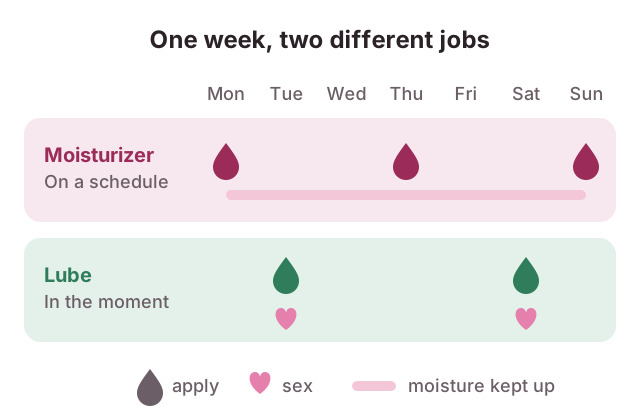
Lube is for the moment; a vaginal moisturizer is for the rest of the week. You use lubricant during sex to cut friction, and it only helps while it’s there. You use a vaginal moisturizer on a schedule, every one to three days, whether or not you’re having sex, to ease the everyday dryness, itching and soreness that can come with menopause and other hormone changes. If dryness only bothers you during sex, lube may be all you need. If you feel it on ordinary days too, you probably want both.
What’s the difference between a lubricant and a vaginal moisturizer?
They overlap in the pharmacy aisle and sometimes on the label, but they’re built for different jobs.
| Lubricant | Vaginal moisturizer | |
|---|---|---|
| Main job | Reduces friction so sex is more comfortable and more pleasurable | Keeps vaginal tissue moist day to day |
| When you use it | Just before or during sex, toy play or masturbation | On a schedule, sex or not |
| How often | Every time, topping up as needed | Every one to three days, depending on the product |
| Where it goes | In and around the vagina, or on a partner, condom or toy | Inside the vagina |
| How long it works | For the session | Longer-acting; some brands claim up to 3 days |
| Main types | Water-, silicone- or oil-based | Usually gels or creams; some come as inserts |
The Menopause Society describes lubricants as products that reduce discomfort and increase pleasure by decreasing friction, and moisturizers as products used regularly, often several times a week, with the goal of reducing the daily symptoms of genitourinary syndrome of menopause (GSM). Cleveland Clinic adds that moisturizers are applied every one to three days because they’re longer-acting, while lubricants are meant for intercourse.
Can you use lube as a moisturizer?
Not really. Lube isn’t designed to stay put or to keep working for days, so using it as a daily moisturizer means reapplying constantly and getting less out of it. It also means exposing delicate tissue, day after day, to whatever your lube contains. The Menopause Society advises avoiding lubricants with flavors (sugar), warming ingredients, or preservatives and solvents such as propylene glycol and parabens, which can irritate some women. If a lube already stings during sex, our guide to why lube burns explains the usual suspects, and our lube ingredients guide decodes the label.
While you’re at it, don’t borrow from the bathroom shelf either. The NHS warns against putting creams, lotions or moisturizers that aren’t made for the vagina in or around it, because they can cause irritation or infection. That includes your hyaluronic acid face serum.
Can you use a vaginal moisturizer as lube?
Technically, sometimes, but that’s not what they’re built for. Take Replens: it’s FDA-cleared as a personal lubricant, yet the company recommends applying it at least two hours before sex “to allow proper moisturization.” That’s a moisturizer working in the background, not a lube you reach for mid-kiss.
So the realistic setup is both. A moisturizer keeps the tissue in better shape between sessions, and lube handles the friction of the session itself. Two compatibility details are easy to miss:
- Condoms. Oil-based lubricants can damage condoms, per The Menopause Society. Some moisturizers have their own limits too: Replens says it works with latex and polyisoprene condoms but not polyurethane ones. Check every product that’s in play.
- Timing. If your moisturizer’s label says to apply it hours before sex, move it to the morning or the night before rather than skipping it.
For a side-by-side of two popular moisturizers, see Replens vs Revaree.
Lube or moisturizer for dryness: which do you need?
Start with where and when you feel it.
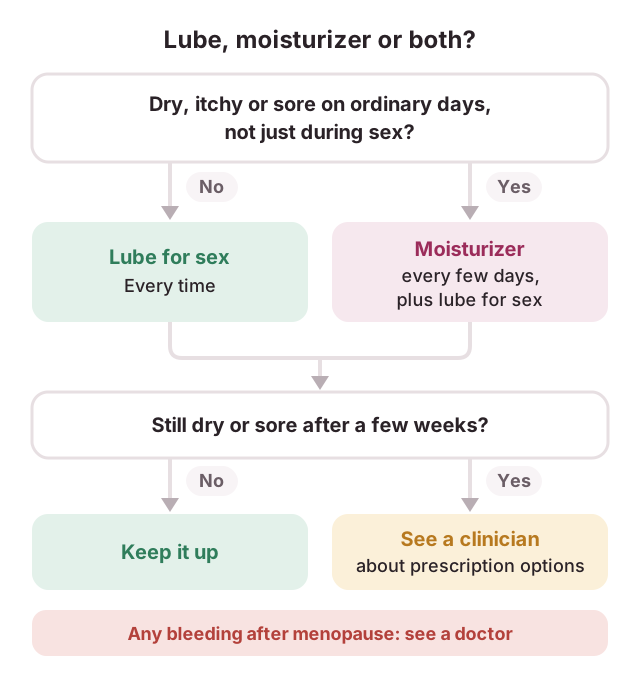
- Only during sex? Start with a good lube, used generously and topped up as you go. Our lube guide explains water-based vs silicone. Giving yourself more time to get aroused helps too; the NHS lists lack of arousal as one cause of dryness.
- On ordinary days too? The Menopause Society describes GSM symptoms that show up outside the bedroom: discomfort when you wipe after peeing or wear certain clothes, burning, itching or irritation of the vulva. That pattern is what moisturizers are for. Use one on a schedule and keep lube for sex.
- Still uncomfortable after a few weeks of both? The NHS suggests seeing a doctor if dryness lasts a few weeks and self-care isn’t helping, and MedlinePlus says to contact your provider if symptoms don’t go away with a water-soluble lubricant. Prescription vaginal estrogen comes as a cream, tablet, suppository or ring, and there are non-estrogen prescriptions as well. Our guide to painful sex after menopause covers them.
Menopause isn’t the only cause, by the way. The NHS lists pregnancy and breastfeeding, hormonal contraceptives, antidepressants, cancer treatments, a hysterectomy, diabetes and Sjögren’s syndrome among the reasons a vagina can be drier than usual. The same two tools apply, though it’s worth asking your doctor whether something on that list is behind it.
How to use a moisturizer and lube together
A routine that’s easy to keep:
- Pick fixed days for the moisturizer. Anchor it to something you already do, like Sunday and Wednesday bedtime, and follow your product’s directions on frequency.
- Keep lube where you have sex. Within arm’s reach beats in a drawer across the room. Use more than you think you need, and reapply.
- Mind the gap before sex. If your moisturizer needs time to absorb, apply it well before you expect to have sex.
- Wash with water or an unperfumed soap. The NHS advises against perfumed soaps, washes and douches in and around the vagina, and MedlinePlus adds scented lotions and perfumes to the list.
- Keep some kind of sexual stimulation in your life, if you want it. The Menopause Society notes that regular sexual stimulation, with a partner, alone or with a vibrator, promotes blood flow and natural secretions.
If you’re just starting to sort out menopause changes, our guide to sex and menopause is a good overview.
Frequently asked questions
What’s the difference between lubricant and moisturizer?
Lubricant reduces friction during sex and works only while you’re using it. A vaginal moisturizer is applied on a schedule, typically every one to three days, to keep the tissue moist and ease everyday dryness, itching and soreness. Plenty of people with menopause-related dryness need both, and they work fine side by side.
Can you use lube as a moisturizer?
It isn’t a good substitute. Lube isn’t built to last between sessions, so you’d be reapplying constantly, and daily exposure to some lube ingredients, such as flavors, warming agents, propylene glycol or parabens, can irritate sensitive tissue. A product made as a vaginal moisturizer is the better tool for everyday dryness.
Can you use a moisturizer as lube?
Some moisturizers are technically cleared as lubricants, but they’re usually designed to be applied ahead of time: Replens, for example, recommends at least two hours before sex. For sex itself, a dedicated lube is the better tool, and you can use the two together.
Should I use lube or moisturizer for dryness?
If you’re only dry during sex, start with lube. If you feel dry, itchy or sore on ordinary days, add a moisturizer on a schedule and keep using lube for sex. If neither helps after a few weeks, see a clinician about prescription options.
Sources
Spotted an error or something out of date? Email [email protected] and we’ll take a look.
More guides

Guide · Toy Safety & Care
Body-Safe Toy Materials: What to Choose and What to Avoid
Not every material is equally safe. Learn which materials are non-porous and easy to clean, and which ones to avoid.
Updated

Guide · Toy Safety & Care
How to Buy Sex Toys Discreetly: Packaging, Billing and Delivery
What discreet shipping really looks like, what shows up on your bank statement, and how to keep emails, deliveries and gifts private in a shared home.
Updated