Replens vs Revaree: Polycarbophil Gel vs Hyaluronic Acid
Replens is a polycarbophil gel; Revaree is a hyaluronic acid insert. Compare ingredients, routines and evidence, and know when to ask about vaginal estrogen.

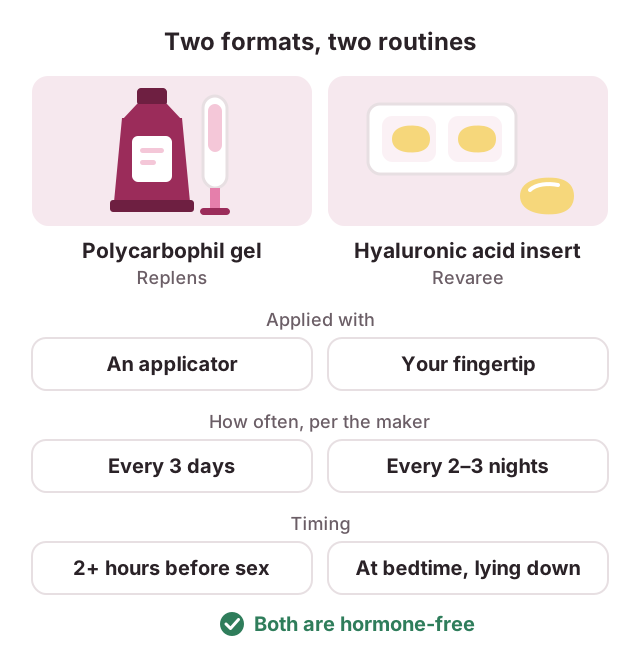
Replens and Revaree are both hormone-free vaginal moisturizers that you use every few days, not right before sex. The real differences are format and routine. Replens is a polycarbophil gel you put in with an applicator about every three days; Revaree is a small hyaluronic acid insert you place with your fingertip at bedtime every two to three nights. The research behind each is modest, and we couldn’t find a trial that tests the two brands head to head. So the useful question isn’t which one is better. It’s which one fits your body, your sex life and your week.
If you’re new to menopause-related dryness, our guide to sex and menopause covers the basics first.
Replens vs Revaree at a glance
The formats, directions and condom guidance below come from each maker’s own product page, and the Replens ingredient comes from its published ingredient list (more on that below). Formulas and directions can change, so the leaflet in your box always has the final word.
| Replens Long-Lasting Vaginal Moisturizer | Revaree | |
|---|---|---|
| Moisturizing ingredient | Polycarbophil gel | Hyaluronic acid, 5 mg per insert |
| Format | 8 prefilled single-use applicators, or a 35 g tube with a reusable applicator (14 applications) | Solid insert, 10 per box |
| How it goes in | Applicator | Your fingertip, “like you would a tampon” |
| How often | “Every three days” for most people; Replens says daily use is safe | “Once every 2–3 nights” |
| Timing | At least 2 hours before sex | At bedtime, then lie down for 30 minutes |
| Condoms | Works with latex and polyisoprene, not polyurethane | “Not compatible with condoms” |
| Hormones | None | None |
What’s in them: polycarbophil vs hyaluronic acid
Replens: a gel designed to cling
Replens says its gel contains “a bioadhesive that allows it to attach to dry cells and deliver continuous moisture,” and that one application keeps working for up to three days. The ingredient list, as published in a 2018 JAMA Internal Medicine trial that used Replens, reads: purified water, glycerin, mineral oil, polycarbophil, carbomer homopolymer type B, hydrogenated palm oil glyceride, sorbic acid and sodium hydroxide. The researchers describe polycarbophil as a mucoadhesive. That’s the clingy part.
Two label details matter in real life. Replens contains glycerin, which the company says helps hold moisture over time; if glycerin-heavy lubes have stung you before, read our guide to lube ingredients first. And Replens recommends stopping four days before a Pap test.
Revaree: hyaluronic acid in a dissolving insert
Bonafide, which makes Revaree, lists 5 mg of hyaluronic acid per insert, plus “semi-synthetic glycerides and sodium salt.” The company says hyaluronic acid works “by attracting and retaining moisture in the vaginal lining.” The routine is built around bedtime: pull one out of its plastic strip, slide it in with your fingertip as far as it comfortably goes, and lie down while it dissolves. Bonafide suggests staying horizontal for 30 minutes “to reduce mess and maximize absorption.”
One labeling quirk: on paper, both products are personal lubricants. Replens says it’s FDA-cleared “as a personal lubricant for vaginal application,” and Bonafide describes Revaree the same way. In practice, both are designed to be used on a schedule, as moisturizers, which is a different job from lube. Our moisturizer vs lube guide explains why you might want both.
Revaree vs Revaree Plus: what’s the difference?
Revaree Plus doubles the hyaluronic acid to 10 mg per insert and adds sweet almond oil. Bonafide pitches it “for extra strength.” Its comparison page doesn’t give separate directions for Plus, so follow the leaflet in that box, including for condoms. If you avoid nut-derived ingredients, note the almond oil.
What we couldn’t find is a published trial showing that 10 mg works better than 5 mg. So if original Revaree is helping, there’s no evidence-based reason to trade up. If it isn’t helping after a fair trial, we’d book a conversation with a clinician before reaching for the stronger box.
Does the research favor Replens or hyaluronic acid?
Not clearly. Here’s what the best-known trials of each ingredient found.
Polycarbophil (Replens). In the 2018 JAMA Internal Medicine trial, 302 postmenopausal women with moderate to severe symptoms were randomly assigned to Replens, a low-dose vaginal estradiol tablet or a placebo for 12 weeks. Pain with penetration was the most bothersome symptom for 60% of them. All three groups improved by similar amounts, and neither Replens nor estradiol beat the placebo, which was itself a plain hydroxyethylcellulose gel used on a schedule. The authors suggested that a moisturizer’s mucoadhesive design may not be necessary for relief.
Hyaluronic acid (Revaree-style inserts). A 2024 pilot trial in the journal Menopause randomly assigned 49 women to either a 5 mg hyaluronic acid insert in a semi-synthetic glyceride base (the same strength and base Bonafide lists for Revaree) or a low-dose estradiol cream, each used twice a week for 12 weeks. Both groups improved, more than 90% in each group said they felt better, and the researchers found no clinically meaningful difference between the two. Bonafide funded the study, it was run at a single center, and the authors themselves note that studies of vaginal hyaluronic acid so far have been small. So when Revaree’s marketing says it was “clinically tested” to work “as effectively as topical estrogen,” read that as promising, not settled.
Head to head? We couldn’t find a published trial comparing Replens with Revaree.
Our read: neither ingredient has shown a clear edge, and in the largest trial a plain gel did about as well as Replens. Pay for the format you’ll actually use consistently, not for a molecule that hasn’t proved itself superior.
Replens vs estrogen cream: is a moisturizer a hormone treatment?
No. Neither Replens nor Revaree contains hormones, and both makers say so plainly. They add moisture. Vaginal estrogen is a prescription hormone that acts on the tissue itself. In the 2018 trial, the estradiol tablet moved lab measures of vaginal health far more than placebo did: vaginal pH fell from above 5 to 5 or below in 46% of the estradiol group, versus 12% on placebo, even though symptom scores ended up similar.
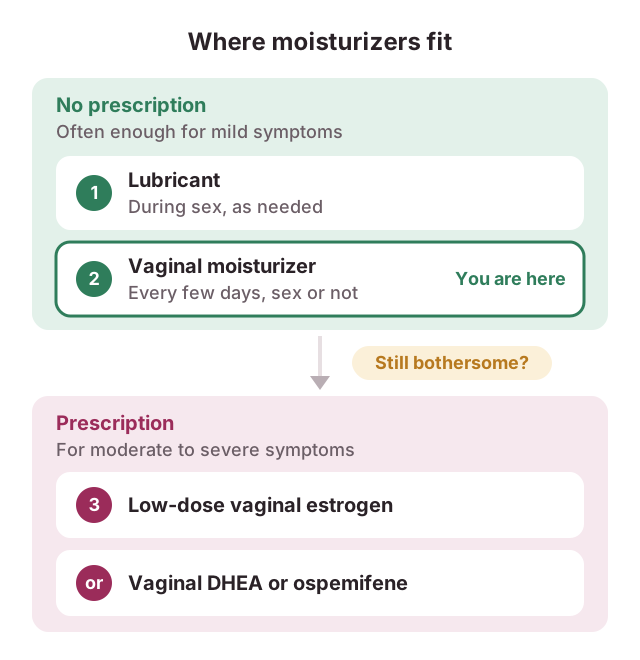
The Menopause Society’s 2020 position statement on genitourinary syndrome of menopause (GSM, the medical name for menopause-related vaginal and urinary changes) draws the line like this. Nonhormone products sold without a prescription give enough relief for most women with mild symptoms. Low-dose vaginal estrogen, vaginal DHEA, systemic estrogen and ospemifene are effective treatments for moderate to severe GSM. The right choice depends on how severe your symptoms are, what’s safe for you and what you prefer.
When vaginal estrogen is worth a conversation
Going by that position statement, we’d book an appointment with a gynecologist or primary care clinician if:
- your symptoms feel moderate to severe rather than mild: sex hurts, or dryness and soreness intrude on ordinary days;
- you’ve used a moisturizer consistently for a few weeks, plus lube for sex, and you’re still uncomfortable;
- you’ve been avoiding estrogen out of worry and want a real answer for your situation. With low-dose vaginal estrogen, vaginal DHEA or ospemifene, the statement says you don’t need a progestogen, though endometrial safety hasn’t been studied in trials longer than a year.
If you’ve had breast cancer, the statement says there isn’t yet enough data to confirm the safety of vaginal estrogen, DHEA or ospemifene, and that care should weigh your own needs alongside your oncologist’s recommendations. Bring your oncologist into the decision before you add anything beyond a hormone-free moisturizer. Our guide to painful sex after menopause walks through each prescription option.
Gel or insert? How to match the format to your life
Since neither ingredient has proved itself better, choose on practicalities:
- If you use condoms, Bonafide says Revaree isn’t compatible with them. Replens works with latex and polyisoprene condoms but not polyurethane. Not sure what yours are made of? See latex vs non-latex condoms.
- If you dislike applicators, an insert goes in with a fingertip. If you’d rather not touch anything, a prefilled Replens applicator is single-use: twist off the tip, insert, squeeze two or three times, throw it away.
- If bedtime is your only quiet moment, Revaree is built around it. If your days are unpredictable, Replens can go in at any time, ideally at least two hours before sex.
- If lying still afterward isn’t realistic, note that Bonafide recommends 30 minutes lying down to limit leakage.
- If you react to glycerin, Replens contains it; Revaree’s listed ingredients don’t.
- If a Pap test is on the calendar, Replens asks you to pause four days before.
- If packaging waste bothers you, Replens’ tube with a reusable applicator holds 14 applications, while the prefilled box holds 8 single-use applicators. Revaree comes 10 inserts to a box, each in a plastic strip.
Give whichever you pick a consistent run before you judge it. Bonafide says Revaree can relieve dryness in as little as nine days; the Replens trial measured results at 12 weeks.
Frequently asked questions
Which is better, Replens or Revaree?
Neither has been shown to beat the other, and we couldn’t find a trial that compares them directly. Replens is a polycarbophil gel used with an applicator about every three days; Revaree is a hyaluronic acid insert used every two to three nights at bedtime. Pick the routine you’ll stick with, and factor in condoms: Revaree’s maker says it isn’t condom-compatible.
Do hyaluronic acid vaginal suppositories work?
The evidence is encouraging but thin. A 2024 pilot trial funded by Revaree’s maker found that a 5 mg hyaluronic acid insert worked about as well as low-dose estrogen cream over 12 weeks, but it included only 49 women. Treat it as a reasonable hormone-free option, not a proven equal to estrogen.
What’s the difference between Revaree and Revaree Plus?
Revaree Plus has 10 mg of hyaluronic acid per insert instead of 5 mg, plus sweet almond oil, and Bonafide markets it as the extra-strength version. Its comparison page doesn’t list separate directions for Plus, so check the leaflet. We found no published evidence that the higher dose works better.
Is Replens as good as estrogen cream?
They do different jobs. Replens adds moisture, while vaginal estrogen is a prescription hormone that changes the tissue itself. In one large trial, Replens, an estradiol tablet and a placebo gel relieved symptoms by similar amounts, but The Menopause Society still lists low-dose vaginal estrogen among the effective treatments for moderate to severe symptoms.
Is a vaginal moisturizer with hyaluronic acid better than one without?
Not proven. Hyaluronic acid has some encouraging small trials, but we found no study showing it beats polycarbophil, and in the largest moisturizer trial a plain gel did about as well as Replens. Choose on format, routine and condom use.
Sources
- Replens: Long-Lasting Vaginal Moisturizer
- Bonafide: Revaree and Revaree Plus
- The North American Menopause Society (now The Menopause Society): The 2020 genitourinary syndrome of menopause position statement
- JAMA Internal Medicine (2018): Efficacy of vaginal estradiol or vaginal moisturizer vs placebo for treating postmenopausal vulvovaginal symptoms
- Menopause (2024): A randomized, pilot trial comparing vaginal hyaluronic acid to vaginal estrogen for genitourinary syndrome of menopause
Spotted an error or something out of date? Email [email protected] and we’ll take a look.
More guides

Guide · Toy Safety & Care
Body-Safe Toy Materials: What to Choose and What to Avoid
Not every material is equally safe. Learn which materials are non-porous and easy to clean, and which ones to avoid.
Updated

Guide · Toy Safety & Care
How to Buy Sex Toys Discreetly: Packaging, Billing and Delivery
What discreet shipping really looks like, what shows up on your bank statement, and how to keep emails, deliveries and gifts private in a shared home.
Updated