Lube Ingredients Explained: Glycerin, Parabens, pH and Osmolality
How to read a lube label: what glycerin, propylene glycol and parabens do, which pH and osmolality numbers to look for, and what “pH-balanced” really means.
Flip the bottle over and look for three things. First, glycols such as glycerin and propylene glycol: they keep lube slippery, and they’re the main reason many water-based lubes are far more concentrated than your body’s own fluids. Second, preservatives such as parabens. Third, add-ons like fragrance, flavor, warming or numbing agents, which clinicians suggest skipping if you’re prone to irritation. If the brand publishes numbers, the World Health Organization’s guidance for vaginal use is a pH of about 4.5 and an osmolality ideally no higher than 380 mOsm/kg, with 1,200 as the upper limit.
None of these ingredients is automatically dangerous, and plenty of people use ordinary glycerin-and-paraben lubes without a second thought. But if a lube has ever burned, itched or seemed to set off an infection, the answer is usually printed somewhere on that label.
How to read a lube ingredient label
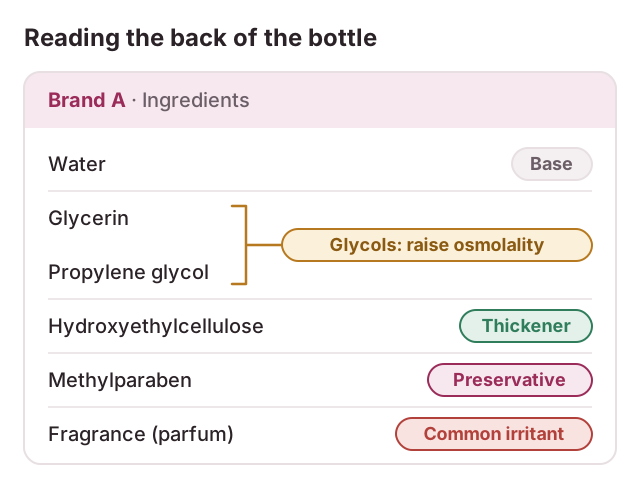
Almost every ingredient falls into one of these groups:
- The base. Water in water-based lubes. In silicone lubes, silicones such as dimethicone, cyclomethicone or dimethiconol. Oil-based lubes are a different animal, covered in our guide to coconut oil and other kitchen swaps.
- Humectants (glycols). Glycerin (also listed as glycerol), propylene glycol and polyethylene glycols such as PEG-8 hold on to water and add slip.
- Thickeners. Hydroxyethylcellulose, xanthan gum, agar and carbomer give a gel its body.
- Preservatives. Anything containing water needs one to stop microbes from growing.
- Extras. Fragrance, flavor, sweeteners, color, warming or tingling agents, numbing agents and spermicide.
In the US, the FDA regulates personal lubricants as Class II medical devices that go through 510(k) review (product code NUC). Clearance won’t put an osmolality figure on the box, though. A 2025 review in Canadian Family Physician points out that osmolality values are typically unavailable to shoppers, which is why the ingredient list ends up doing most of the work.
Why do lubes contain glycerin and propylene glycol?
Glycols are effective humectants: they stop a water-based lube from drying out too fast and give it a slick feel. The catch is concentration. According to the WHO advisory note, the amount of glycol is the main factor that sets a lube’s osmolality. To keep a lube at or below 1,200 mOsm/kg, the WHO works out that glycerin should make up no more than 9.9% of the formula by weight, or propylene glycol no more than 8.3%. Labels list ingredients, not percentages, so you can’t check this from the bottle.
Warming lubes deserve a special mention, because the WHO notes they often contain high levels of propylene glycol.
Glycerin also has a reputation for feeding yeast. That link is debated and hasn’t been shown in clinical studies; we walk through what the research does and doesn’t show in can lube cause a yeast infection?
Shopping for lube without glycerin or glycol
If you want to skip glycols entirely, you have two routes:
- Silicone lube. It contains no water, so it needs no humectant, and osmolality doesn’t apply to it. In a 2012 lab study published in PLOS ONE, the two silicone lubes tested listed only silicone ingredients and didn’t damage tissue samples. Check your toys first with our Lube Compatibility Checker.
- Glycol-free water-based lube. Look for a short list built on water plus thickeners like hydroxyethylcellulose, xanthan gum, agar or carbomer, with no glycerin, propylene glycol or PEG anywhere on it.
One catch: “glycerin-free” on the front isn’t the same as low osmolality. In the table of 41 commercial lubes printed in the WHO note, a liquid sold as glycerin- and paraben-free measured 4,806 mOsm/kg, four times the WHO’s upper limit. Those measurements date from around 2011 and formulas change, but the lesson holds: read the whole list for other glycols, and look for a published osmolality number.
What is lube osmolality, and why does it matter?
Osmolality is a measure of how many dissolved particles are packed into a liquid. When a lube is much more concentrated than the cells it touches, it pulls water out of them, and the thin lining of the vagina or rectum takes the hit.
For reference, the WHO note puts normal vaginal fluid at 260 to 290 mOsm/kg and semen at 250 to 380. Ideally, it says, a lube shouldn’t exceed 380 mOsm/kg, and it set 1,200 as an interim upper limit because most commercial lubes at the time measured between 2,000 and 6,000.
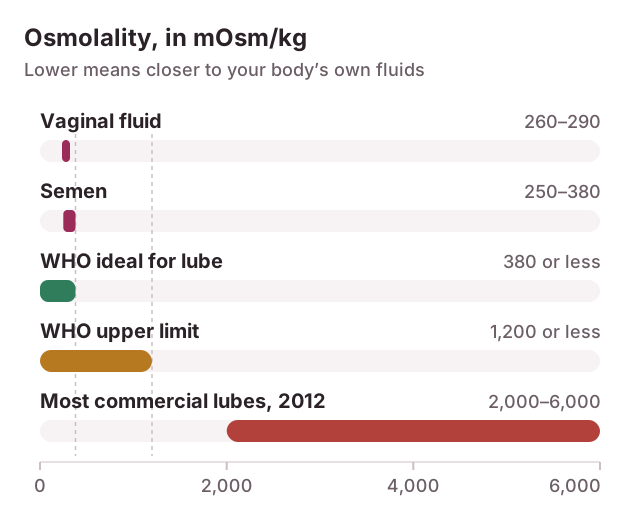
Why it matters: in that 2012 PLOS ONE study, hyperosmolar water-based gels reduced the viability of cervical and colorectal tissue samples and made their surface layer fracture and slough off. Two nearly iso-osmolar water-based gels and both silicone lubes caused no significant changes. The WHO note adds that rectal damage from a high-osmolality lube has been confirmed in a small study of 10 volunteers, and that the effect may matter more for anal use.
Most of this evidence comes from the lab, so it doesn’t mean every high-osmolality lube will hurt you. It’s still the best-supported reason to prefer lower numbers, especially if lube tends to sting (see why lube burns) or you use it for anal sex.
To find the number, check the brand’s website or product page. If it isn’t there, email customer service and ask for “osmolality in mOsm/kg and pH.” No answer? Glycol content is your best proxy: the Canadian Family Physician review notes that avoiding glycols helps keep osmolality closer to the body’s own.
Lube pH balance: what number should you look for?
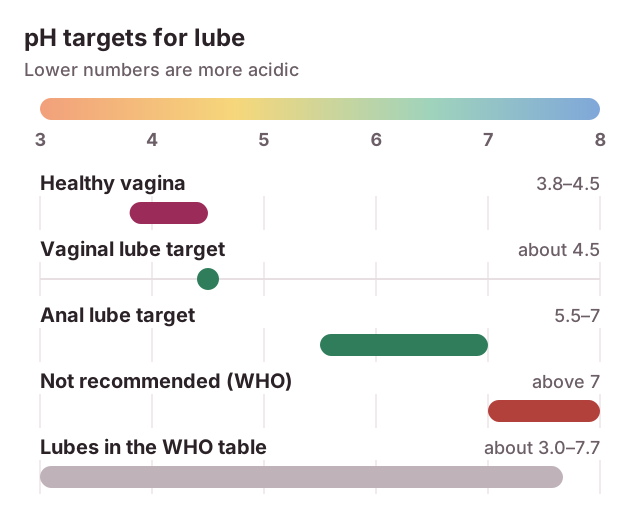
According to the WHO note, a healthy vagina usually sits between pH 3.8 and 4.5, while the rectum is closer to neutral, around pH 7. That gives two different targets:
- Vaginal use: a pH of about 4.5 (the Canadian Family Physician review says roughly 4.0 to 4.5).
- Anal use: a pH between 5.5 and 7.
- Above 7: not recommended in the WHO note.
The WHO admits these targets can’t be met by a single bottle, so if one lube does double duty, pick the target that matches how you use it most. The reasoning behind the vaginal number is that a higher vaginal pH is linked to a greater risk of bacterial vaginosis, so a lube shouldn’t push things away from their normal acidity.
The deliberate exception is fertility-friendly lube, which is made to resemble semen rather than vaginal fluid. The review lists a pH of 7.2 to 8.5 and an osmolality of 270 to 360 mOsm/kg for these products. If you’re trying to conceive, read our fertility-friendly lube guide instead.
What “pH-balanced” and “pH-friendly” actually tell you
On their own, not much. Balanced to what? A lube at pH 7 fits the anal target but is far less acidic than a healthy vagina, and a fertility lube is balanced to semen. In the WHO note’s product table, measured pH ran from 2.98 to 7.67.
“pH-balanced” also says nothing about osmolality. Several lubes in that same table had a vagina-friendly pH between 4.3 and 4.6 and an osmolality above 2,000 mOsm/kg. Treat the phrase as a prompt to look for an actual number, such as “pH 4.0–4.5,” on the bottle or the brand’s site.
Parabens and other preservatives
Water-based lubes must contain a preservative, and the WHO notes that preservatives can cause irritation and sensitization in some people. Parabens are the most common: look for methylparaben and propylparaben, and less often ethylparaben or butylparaben. Other names you’ll see include potassium sorbate, sorbic acid, benzoic acid, sodium benzoate, phenoxyethanol and chlorhexidine gluconate.
How worried should you be about parabens? The FDA says it doesn’t have information showing that parabens as used in cosmetics affect human health. Lube is regulated as a device rather than a cosmetic, but the ingredients are the same. The Canadian Family Physician review still suggests that people prone to irritation or frequent infections avoid them, along with glycols, which is a sensible precaution rather than a verdict.
“Paraben-free” never means preservative-free. One paraben-free gel in the 2012 study used potassium sorbate and benzoic acid instead. If a paraben-free lube still bothers you, the replacement preservative is a suspect too.
Finding lube without glycerin and parabens
If you’re sensitive, this is the combination to look for, and silicone lubes are the easiest place to find it: the two in the 2012 study listed nothing but silicones. For water-based options, you need a list with no glycols and a non-paraben preservative. Some lubes are also marketed as vaginal moisturizers, as the WHO note points out; our guide to vaginal moisturizer vs lube explains how the two products differ.
Fragrance, flavor, warming and numbing agents
These add-ons are the ingredients most worth skipping if you’ve ever had a reaction.
| On the label | What the evidence says | Our take |
|---|---|---|
| Fragrance, parfum, color | The 2025 review lists them among ingredients to avoid if you’re prone to irritation or infections | Skip for internal use |
| Flavor sweetened with glucose or sucrose | On the same avoid list | Keep flavored lube for oral sex |
| “Warming,” “tingling” | Warming formulas are often high in propylene glycol (WHO) | Skip if lube has ever stung |
| Benzocaine, lidocaine, “desensitizing” | Local anesthetics; numbing products are on the review’s avoid list | Avoid, especially for anal sex, because pain is a useful warning |
| Nonoxynol-9 | A spermicide with significant irritant effects; the WHO doesn’t recommend it | Skip |
| Polyquaternium-15 | Increased HIV replication in lab tests; the WHO advised avoiding it pending more evidence | Lab-only signal, but easy to avoid |
| Chlorhexidine gluconate | An antiseptic on the review’s avoid list | Skip if you’re prone to irritation |
Frequently asked questions
Is lube without glycerin better?
Not for everyone. Glycerin is a common humectant that many people use without problems. Going glycerin-free makes sense if lube stings or you’re prone to irritation or recurring infections, because glycols drive osmolality. Check the rest of the list for propylene glycol or PEG too.
What pH should lube be?
For vaginal use, about 4.5, or roughly 4.0 to 4.5. For anal use, between 5.5 and 7. The WHO note doesn’t recommend lubes above pH 7; fertility-friendly lubes are the planned exception, because they’re designed to match semen.
What is a good osmolality for lube?
The WHO’s ideal is 380 mOsm/kg or less, close to vaginal fluid and semen, with 1,200 mOsm/kg as the upper limit for a water-based lube. Osmolality doesn’t apply to pure silicone lube, which contains no water.
Is there a lube without glycerin or glycol?
Yes. Pure silicone lubes contain no water and need no glycols, and some water-based lubes use thickeners such as hydroxyethylcellulose or xanthan gum instead. Hybrid lubes contain water, so read their labels as you would a water-based one.
Sources
- WHO/UNFPA/FHI360: Use and procurement of additional lubricants for male and female condoms (advisory note, 2012)
- Canadian Family Physician (2025): Approach to lubricant use for sexual activity
- PLOS ONE (2012): Is wetter better? An evaluation of over-the-counter personal lubricants for safety and anti-HIV-1 activity
- FDA: Parabens in cosmetics
- FDA: Product classification, lubricant, personal (product code NUC)
Spotted an error or something out of date? Email [email protected] and we’ll take a look.
More guides

Guide · Toy Safety & Care
Body-Safe Toy Materials: What to Choose and What to Avoid
Not every material is equally safe. Learn which materials are non-porous and easy to clean, and which ones to avoid.
Updated

Guide · Toy Safety & Care
How to Buy Sex Toys Discreetly: Packaging, Billing and Delivery
What discreet shipping really looks like, what shows up on your bank statement, and how to keep emails, deliveries and gifts private in a shared home.
Updated