Fertility-Friendly Lube: What’s Safe When Trying to Conceive
What “sperm-friendly” lube means under FDA rules, what research says about regular lube and sperm, which lubes are cleared, and when to see a specialist.

Yes, you can use lube while you’re trying to conceive. If you want one that’s been tested on sperm, look for a lubricant the FDA has cleared as compatible with sperm, eggs and embryos. Many ordinary lubes slowed sperm down in lab tests, though the best real-world study we found didn’t show lube lowering the odds of pregnancy. Think of a fertility-friendly lube as removing one small variable, not as a fertility treatment.
What does “fertility-friendly” lube actually mean?
“Fertility-friendly,” “sperm-friendly” and “TTC” (trying to conceive) are the words on the front of the box. The FDA’s term is a mouthful: “Lubricant, Personal, Gamete, Fertilization, And Embryo Compatible,” product code PEB. It’s a Class II medical device, and, a little surprisingly, it sits under the same federal regulation as condoms (21 CFR 884.5300).
The FDA’s definition says a PEB lubricant “is compatible with sperm, oocytes, and embryos and can be used by couples trying to conceive.” The same entry describes it as non-toxic to sperm, eggs and developing embryos, and says it doesn’t interfere with fertilization. The same lubes can also be used in fertility clinics to ease the insertion of exam instruments and other devices.
What does that testing look like in practice? Pre-Seed’s 510(k) summary, the paperwork behind its 2020 clearance, gives one example:
- Human sperm survival assay: sperm motility had to stay at or above 80% of the control sample 24 hours after 30 minutes of exposure to a 10% concentration of the lubricant.
- pH and osmolality: the specification is a pH of 7.0 to 7.4 and an osmolality of 260 to 370 mOsm/kg.
- Other testing: biocompatibility (including a vaginal irritation test) and condom compatibility.
Those numbers belong to one product, not to the whole category. The category is defined by what the testing shows, not by one magic pH.
Does regular lube hurt sperm?
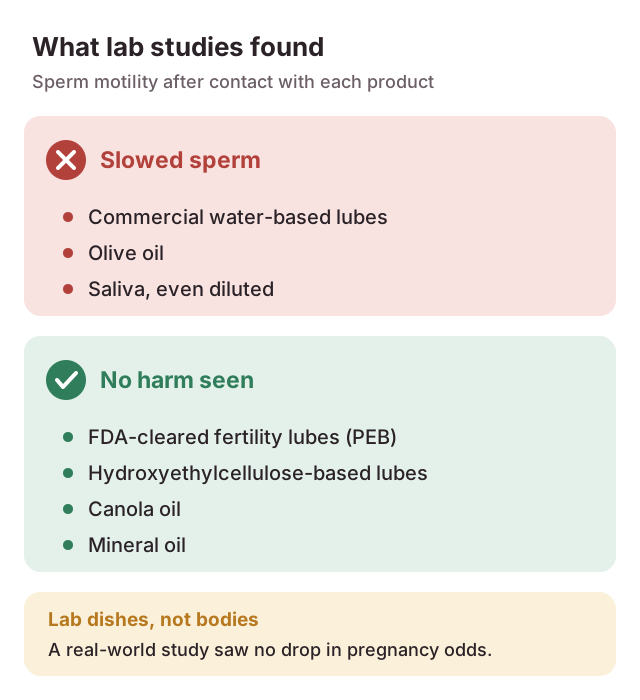
In a lab dish, often yes. The American Society for Reproductive Medicine (ASRM) summarizes the research in its committee opinion on optimizing natural fertility:
- Commercially available water-based lubricants cut sperm motility by 60% to 100% within 60 minutes of incubation.
- Some over-the-counter lubricants, olive oil and saliva harmed sperm motility and speed even when diluted to 6.25%.
- Canola oil, mineral oil and hydroxyethylcellulose-based lubricants didn’t show those effects.
But a lab dish isn’t a body, and the real-world data point the other way. In a 2012 study, 296 women aged 30 to 44 with no history of infertility kept daily diaries of sex and lube use for up to six months. Those who used lube during the fertile window had a similar chance of conceiving per cycle to those who didn’t (fecundability ratio 1.05, 95% confidence interval 0.59 to 1.85). The authors’ conclusion was careful: lube use “does not appear to reduce the probability of conceiving.” ASRM cites the same finding.
So the evidence is thin and a bit contradictory. One modest study isn’t the last word, and we couldn’t find a randomized trial. Our read: if you need lube anyway (and plenty of people do: in that study, 43% of women used it at least occasionally), a PEB-cleared lube takes the lab-dish worry off the table. If you’ve been using regular lube, don’t panic about past cycles.
FDA-cleared fertility-friendly lubricants (A to Z)
These are the lubricants we found in the FDA’s 510(k) database under product code PEB, as of November 2026. We’ve listed them alphabetically. This isn’t a ranking, and we haven’t tested them hands-on. Formulas and packaging change, so match the name on the box to the database entry by searching the 510(k) number.
| Product (as named in the FDA database) | 510(k) holder | 510(k) number | Cleared |
|---|---|---|---|
| Actively Trying Personal Lubricant (unfragranced and rose-scented versions) | CC Wellness | K212705, K212885 | 2022 |
| Astroglide TTC Fertility Friendly Personal Lubricant | Biofilm | K141132 | 2015 |
| BabyDance Fertility Lubricant | Fairhaven Health | K162319 | 2017 |
| BioGenesis Fertility Lubricant | Good Clean Love | K190872 | 2019 |
| Conceive Plus | Sasmar | K131355 | 2013 |
| JO Actively Trying Personal Lubricant | United Consortium | K182585 | 2019 |
| Pre-Seed Fertility Lubricant | Church & Dwight | K193450 | 2020 |
Older clearances exist for lubes that may no longer be on shelves, so if you spot a fertility lube that isn’t here, look it up rather than assuming either way.
How to tell if a lube is sperm-friendly in the store
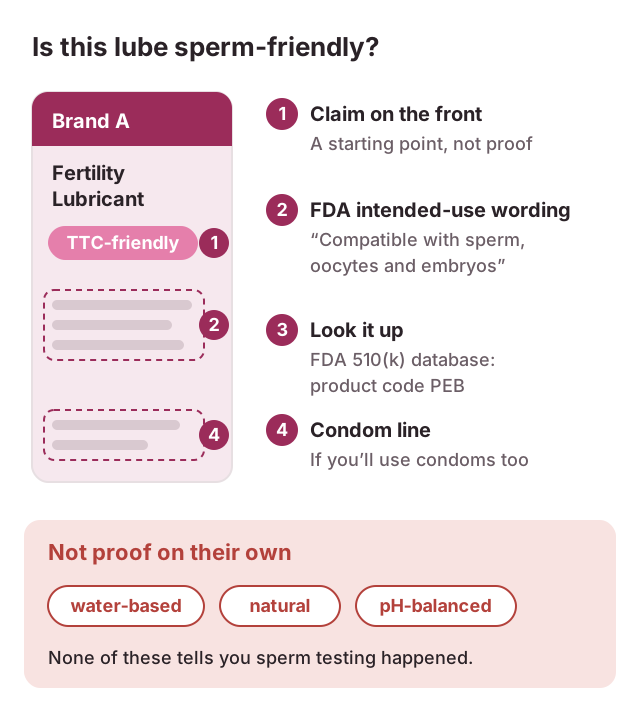
Standing in the family-planning aisle with your phone, here’s the order we’d check things in:
- Find the claim. “Fertility-friendly,” “sperm-friendly” or “TTC” on the front tells you what the maker is aiming for. It’s a starting point, not proof.
- Find the FDA wording. If the box or leaflet describes what the product is for, look for language that echoes the FDA definition: compatible with sperm, eggs (oocytes) and embryos.
- Look it up. Search the FDA’s 510(k) database for the product name. You want product code PEB in the result.
- Check the condom line if you’ll also use it with condoms.
Words that don’t answer the question on their own: “water-based” (the commercial lubes that cut sperm motility in ASRM’s summary were water-based), “natural” (olive oil and saliva are about as natural as it gets) and anything that only talks about feel or pH. If you also care about specific ingredients such as glycerin or parabens, our lube ingredients guide explains what those label words mean.
What to skip while you’re trying
- Saliva and olive oil. Both harmed sperm motility in lab studies, even heavily diluted. They also come with their own issues, which we cover in our guide to coconut oil and other kitchen swaps.
- Your usual drugstore lube, if it isn’t PEB-cleared. It’s probably not sabotaging you, given the real-world data, but it’s the variable that’s easiest to swap out.
- Anything with a spermicide, such as nonoxynol-9. Spermicide exists to stop sperm, so check the label of any lube you use while you’re trying.
Canola oil and mineral oil didn’t harm sperm in the lab studies ASRM cites, but ASRM doesn’t recommend them, and they haven’t been through the testing a PEB clearance requires. Oils have other trade-offs too, which the kitchen-swaps guide linked above covers. For a refresher on lube types in general, see our guide to choosing lube.
When to see a fertility specialist
Lube is a comfort tool. It won’t fix an underlying fertility problem, so don’t let a good tube buy you extra months of waiting. ACOG’s guidance on when to get an infertility evaluation:
- Under 35: after 1 year of regular sex without birth control.
- Over 35: after 6 months of trying.
- Over 40: talk with your ob-gyn about an evaluation now.
ASRM defines infertility the same way (12 months of trying) and also recommends an earlier evaluation after 6 months for women aged 35 and older. Your ob-gyn usually does the first assessment. You may then see a reproductive endocrinologist, an ob-gyn with extra training in infertility, and a partner who produces sperm may see a urologist. ACOG notes that a problem with sperm is the most common cause of male infertility, so evaluation is for both partners, not just the person trying to get pregnant.
Once you do get pregnant, the lube question changes. See our guide to using lube during pregnancy.
Frequently asked questions
Is lube safe when you’re trying to conceive?
Yes. The best real-world study we found showed no drop in the chance of conceiving among couples who used lube during the fertile window. Lab tests do show many ordinary lubes slowing sperm, so if you want the most cautious option, choose one that’s FDA-cleared under product code PEB.
What lube is safe for sperm?
Lubes cleared by the FDA as “gamete, fertilization, and embryo compatible” (product code PEB) are the ones tested for it. The table above lists those we found in the FDA database. In lab studies cited by ASRM, hydroxyethylcellulose-based lubes, canola oil and mineral oil also didn’t harm sperm, but only PEB lubes have an FDA clearance behind the claim.
What’s the best lube for fertility?
We don’t rank them, and no study we know of shows one PEB lube leading to more pregnancies than another. Pick one that’s FDA-cleared, that feels comfortable and that matches any condoms you use outside your fertile window. We’ll update this guide when we’ve tested them hands-on.
Can I use fertility-friendly lube during IUI or IVF?
The FDA category explicitly covers use during fertility procedures to help insert diagnostic and treatment devices. Your clinic may have its own instructions around procedures, though, so ask your care team before you use anything on the day of a procedure.
Sources
- FDA: Product classification, PEB (lubricant, personal, gamete, fertilization, and embryo compatible)
- FDA: 510(k) summary for Pre-Seed Fertility Lubricant (K193450)
- ASRM Practice Committee: Optimizing natural fertility, a committee opinion
- Steiner et al., Obstetrics & Gynecology (2012): Effect of vaginal lubricants on natural fertility
- ACOG: Evaluating Infertility
Spotted an error or something out of date? Email [email protected] and we’ll take a look.
More guides

Guide · Toy Safety & Care
Body-Safe Toy Materials: What to Choose and What to Avoid
Not every material is equally safe. Learn which materials are non-porous and easy to clean, and which ones to avoid.
Updated

Guide · Toy Safety & Care
How to Buy Sex Toys Discreetly: Packaging, Billing and Delivery
What discreet shipping really looks like, what shows up on your bank statement, and how to keep emails, deliveries and gifts private in a shared home.
Updated