Can You Use Coconut Oil as Lube? An Honest Look at DIY Swaps
Coconut oil, aloe vera, Vaseline, olive oil and saliva as lube: what works with which condoms, what the infection research says, and what to skip.

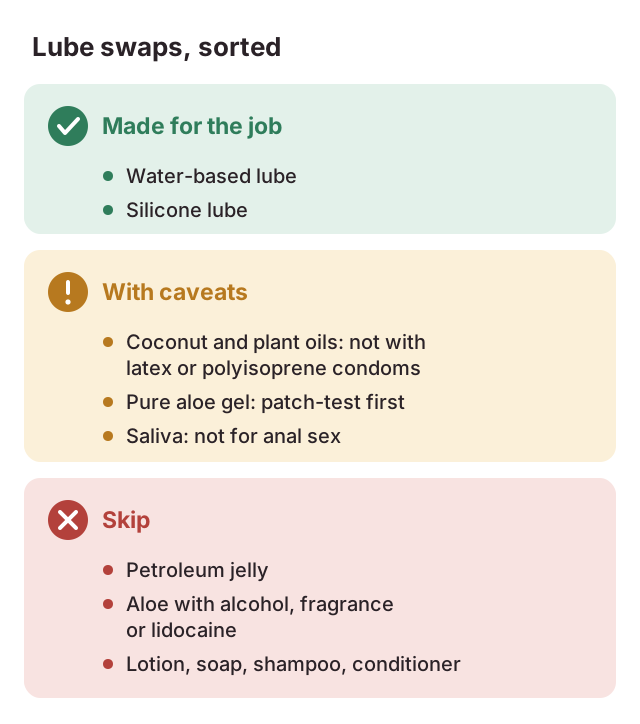
You can use coconut oil as lube, but only in situations where it can’t do damage. Oil weakens latex and polyisoprene condoms, so it’s out whenever one of those is involved. A small study also linked putting oils inside the vagina with more yeast. For external massage, or with polyurethane or nitrile condoms, it’s a reasonable pick. For everything else, a water- or silicone-based lube is the safer bet.
That’s coconut oil. The rest of the pantry and bathroom cabinet ranges from “fine in a pinch” to “please don’t.”
Can coconut oil break a condom?
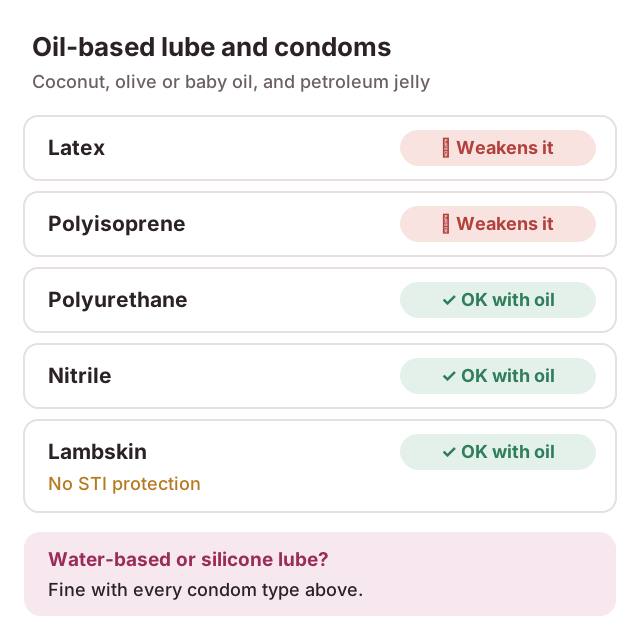
Yes, if the condom is latex or polyisoprene. Planned Parenthood’s guidance is blunt: only use water-based or silicone lube with latex condoms, and “don’t use anything with oil, because oil can damage latex condoms.” Polyisoprene, the latex-free synthetic rubber, has the same problem. The CDC lists oil-based products such as baby oil, lotion, petroleum jelly and cooking oil as things that can make a condom break.
Oil is fine with other materials. You can generally use oil-based lube with polyurethane and nitrile condoms, and with lambskin condoms, though lambskin doesn’t protect against STIs. If you’re not sure what your condoms are made of, the box will tell you; our guide to latex vs non-latex condoms walks through each material.
Is coconut oil safe for vaginal use?
This is where the evidence gets thin, and we’d rather say so than pretend otherwise. The best data we found come from a 2013 study that followed 141 sexually active women in Los Angeles:
- Women who had put oils inside the vagina in the past month were more likely to have Candida (yeast) present: 44.4% compared with 5% of women who hadn’t.
- Women who had used petroleum jelly inside the vagina were 2.2 times as likely to test positive for bacterial vaginosis (BV), even after adjusting for other factors.
That’s a small, observational study. It shows an association, not proof that oil causes yeast, and the oil finding didn’t include the adjustments the petroleum jelly result did. We couldn’t find a single trial of coconut oil as a lube. But the one signal we have points in the wrong direction, so if you get yeast infections or BV easily, we’d skip oils inside the vagina. Our guide to whether lube can cause a yeast infection covers what the research says about commercial lubes too.
Where coconut oil makes sense: massage, solo play on the outside, and partnered sex with polyurethane or nitrile condoms or with no condom when STIs and pregnancy aren’t a concern. Oil can also stain sheets, so put a towel down.
Water-based lube vs coconut oil
The short version: a water-based lube works with every condom type, while coconut oil rules out latex and polyisoprene. Water-based lubes do need reapplying during longer sessions; if that bugs you, silicone lube lasts longer and is also safe with latex. The trade-offs between lube types are in our guide to choosing lube, and you can check a specific lube, condom and toy combination with our Lube Compatibility Checker.
One label trap: if a store-bought lube says “coconut” on the front, go by the condom-compatibility line on the back, not the word on the front.
Can you use aloe vera as lube?
Possibly, if it’s the right aloe. There’s very little evidence either way. We couldn’t find any study testing plain aloe vera gel as a sexual lubricant. The NIH’s complementary health center (NCCIH) says topical aloe gel is generally well tolerated on skin, with occasional reports of burning, itching, rash and eczema.
The bigger issue is what else is in the bottle. An after-sun gel isn’t necessarily pure aloe:
- Read the ingredient list. If you see alcohol (often “alcohol denat.”), fragrance or “parfum,” dyes, or a numbing agent such as lidocaine, put it back. Those are the add-ons that tend to sting on genital skin; our guide to why lube burns explains why.
- Patch-test first. Dab a little on your inner arm and wait to see if you react. Given those occasional skin reactions, it’s worth doing before using aloe anywhere more sensitive.
- Condoms: if you’re relying on one, use a lube that’s labeled compatible with your condom type, or check the directions on the condom package, as Planned Parenthood suggests for any lube you’re unsure about.
Is Vaseline safe as lube?
We’d skip it. Petroleum jelly is on the CDC’s list of products that can make condoms break, and in the 2013 study it was the product linked with a higher rate of BV. Even with no condom in the picture, that BV link is reason enough to keep it out of the vagina.
Can you use olive oil as lube?
Olive oil, avocado oil, vegetable oil and the rest of the cooking oils follow the same rules as coconut oil: not with latex or polyisoprene condoms (the CDC names cooking oil specifically), and the same caution about using oils inside the vagina. Baby oil is on the CDC’s list too. If you’re trying to conceive, read the section on that below before you reach for olive oil.
Is saliva OK as lube?
Saliva is the lube everyone carries, and we don’t know of good research on it for touching on the outside. For anal sex, though, there’s a specific reason to skip it. A survey of 1,312 men who have sex with men at a Melbourne sexual health clinic found that using a partner’s saliva as lube for anal sex was linked with about twice the odds of rectal gonorrhea, after adjusting for other factors. That’s an association rather than proof, but it’s also an easy risk to avoid.
Lotion, soap, shampoo or conditioner?
No to all four. Lotion is on the CDC’s list of products that can break condoms. Soap, shampoo and conditioner are made to be rinsed off hair and skin, not left on the most sensitive tissue you have during sex. If what you want is something slippery for shower sex, a silicone lube is designed to hold up in water.
Trying to conceive or pregnant?
Both change the calculation. When you’re trying to conceive, the question becomes whether a lube slows sperm. Our fertility-friendly lube guide covers the lab research on olive oil and saliva, and the lubes the FDA has cleared for conception. During pregnancy, the condom rules above still apply if you use condoms for STI protection; our guide to lube during pregnancy covers the rest, including coconut oil.
Frequently asked questions
Can you use coconut oil as lube with condoms?
Only with polyurethane, nitrile or lambskin condoms. Oil damages latex and polyisoprene condoms, which can make them break. If you don’t know the material, check the box, and when in doubt use a water-based or silicone lube.
Is water-based lube better than coconut oil?
For most situations, yes, because it works with every condom type and avoids the open questions about oils inside the vagina. Coconut oil is fine for massage and for sex with polyurethane or nitrile condoms. Water-based lube may need reapplying during longer sessions.
Is aloe vera safe as a personal lube?
We couldn’t find any research on aloe as a sexual lubricant. Plain aloe gel is generally well tolerated on skin, though some people react. Skip any aloe product with alcohol, fragrance or numbing agents, and patch-test first.
Can you use Vaseline as lube?
We don’t recommend it. Petroleum jelly can make latex condoms break, and a 2013 study linked using it inside the vagina with a higher rate of bacterial vaginosis.
Can you use olive oil as lube?
The same rules as coconut oil apply: not with latex or polyisoprene condoms, and with caution inside the vagina. It’s fine for massage. If you’re trying to conceive, choose an FDA-cleared fertility-friendly lube instead.
Sources
- Planned Parenthood: Condoms
- CDC: How to Use a Condom
- Brown et al., Obstetrics & Gynecology (2013): Intravaginal practices and risk of bacterial vaginosis and candidiasis infection
- NCCIH (NIH): Aloe Vera
- Chow et al., Sexually Transmitted Infections (2016): Saliva use as a lubricant for anal sex and rectal gonorrhoea
Spotted an error or something out of date? Email [email protected] and we’ll take a look.
More guides

Guide · Toy Safety & Care
Body-Safe Toy Materials: What to Choose and What to Avoid
Not every material is equally safe. Learn which materials are non-porous and easy to clean, and which ones to avoid.
Updated

Guide · Toy Safety & Care
How to Buy Sex Toys Discreetly: Packaging, Billing and Delivery
What discreet shipping really looks like, what shows up on your bank statement, and how to keep emails, deliveries and gifts private in a shared home.
Updated