Can Lube Cause a Yeast Infection, UTI or BV? What Research Shows
Lube rarely causes infections on its own, but oils, spermicide and some ingredients are linked to BV, yeast and UTIs. Here’s the evidence and what to use.

Lube on its own isn’t a well-established cause of yeast infections, BV or UTIs, and using enough of it is usually kinder to your body than going without. The research points at a few specific culprits instead: petroleum jelly and some oils, spermicide, and possibly very concentrated water-based formulas. The popular idea that glycerin feeds yeast sounds plausible but hasn’t been proven.
That distinction matters if you keep getting infections, because swapping one bottle for another won’t fix a problem the bottle didn’t cause. Here’s what each piece of evidence actually shows.
Can lube cause a yeast infection?
Yeast (Candida) lives in many vaginas without causing any trouble; the CDC notes that plenty of people carry it with no symptoms at all. An infection happens when it overgrows. The CDC lists frequent antibiotic use and diabetes among the factors behind repeat infections, though most people with recurrent yeast infections have no obvious trigger.
Glycerin and yeast: the debate
The theory goes like this: glycerin is a sugar alcohol, yeast likes sugar, so glycerin-based lube might feed it. It’s also why you’ll see glycerin-free lubes pitched at people prone to yeast infections.
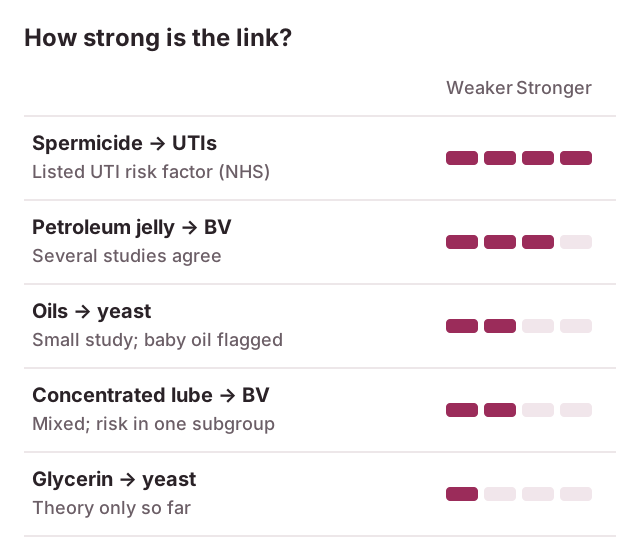
Some clinicians do advise caution. A 2025 review in Canadian Family Physician recommends that people with frequent urogenital infections avoid glycols, including glycerin and propylene glycol. But that’s a precaution. The review doesn’t cite a study showing that glycerin lube causes yeast infections, and we couldn’t find one either. If you’ve noticed a pattern with a glycerin lube, switching is reasonable and costs you little; just know it’s not a guaranteed fix.
Flavored lubes are a separate question. Those sweetened with actual sugars, such as glucose or sucrose, are on the same review’s list of ingredients to avoid if you get frequent infections.
Oils and yeast
A 2013 study followed 141 sexually active women in Los Angeles. Those who had used oils inside the vagina in the past month were far more likely to have Candida present (44.4% compared with 5%). That was a simple comparison that didn’t account for other factors, and having yeast present isn’t the same as having symptoms. The 2025 review adds that recent data suggest baby oil may raise the risk of vaginal yeast infections, while the evidence on coconut oil is mixed and mostly from lab studies. Our guide to coconut oil as lube covers that question in detail.
Can lube cause BV?
Bacterial vaginosis (BV) happens when the vagina’s usual bacteria get crowded out by others. Two lube-related links have research behind them.
Petroleum jelly. In that same Los Angeles study, women who had used petroleum jelly inside the vagina in the past month were 2.2 times as likely to test positive for BV, even after adjusting for other factors. The Canadian Family Physician review says multiple clinical studies have linked petroleum jelly to BV. These are observational studies, so they can’t prove cause, but the pattern is consistent enough that petroleum jelly shouldn’t be your lube.
Very concentrated water-based lube. Some water-based lubes are hyperosmolal, meaning far more concentrated than the body’s own fluids (our lube ingredients guide explains osmolality). A 2025 study compared 58 women exposed once to a hyperosmolal lube during a transvaginal ultrasound with 59 who weren’t. Overall, the lube made no clear difference to new cases of BV. Among Black participants, though, it was linked to roughly double the risk. The groups were small and the authors call for more research, but it’s a reason to favor lower-osmolality lube if BV keeps coming back.
The review also notes that some oil-based lubes can irritate genital tissue and disrupt its bacteria. In its worked example of a patient with recurrent BV, the advice was to stop using oils and switch to a silicone, water-based or hybrid lube without irritating additives.
Can lube cause a UTI?
Plain lube doesn’t appear on the NHS list of UTI risk factors. UTIs usually start when bacteria from the bowel get into the urethra, which is why the NHS prevention advice includes a couple of after-sex habits.
One lube ingredient does show up on that list: spermicide. The NHS lists using spermicide with contraception as a risk factor and advises people prone to UTIs not to use condoms, diaphragms or caps with spermicidal lube on them, and to try non-spermicidal lube instead. Look for nonoxynol-9, the spermicide named in the Canadian Family Physician review, on condom boxes as well as lube bottles.
The NHS also suggests peeing as soon as possible after sex and washing the skin around the vagina with water before and after. The Canadian Family Physician review lists UTIs alongside BV and yeast as infections that certain water-based formulas may make more likely, but doesn’t put a size on that risk.
Friction, microtears and why skipping lube isn’t the fix
Going without lube isn’t automatically the safer choice. The 2025 review describes lubricant use as having “numerous benefits, minimal harms” and notes that it reduces friction and the risk of condom tears.
Sex without enough lubrication means more friction, and friction can leave delicate tissue sore and raw. That soreness can feel a lot like the start of an infection, which is one reason a burning, itchy morning after isn’t always yeast.
You’ll often read that lube prevents “microtears” that let infections in. It’s a plausible idea, but we didn’t find good studies measuring it for yeast, BV or UTIs; the benefits with clearer support are comfort and fewer condom tears. If the main problem is stinging the moment lube goes on, that’s usually irritation rather than infection; our guide to why lube burns covers the likely causes.
How to choose lube if you get recurring infections
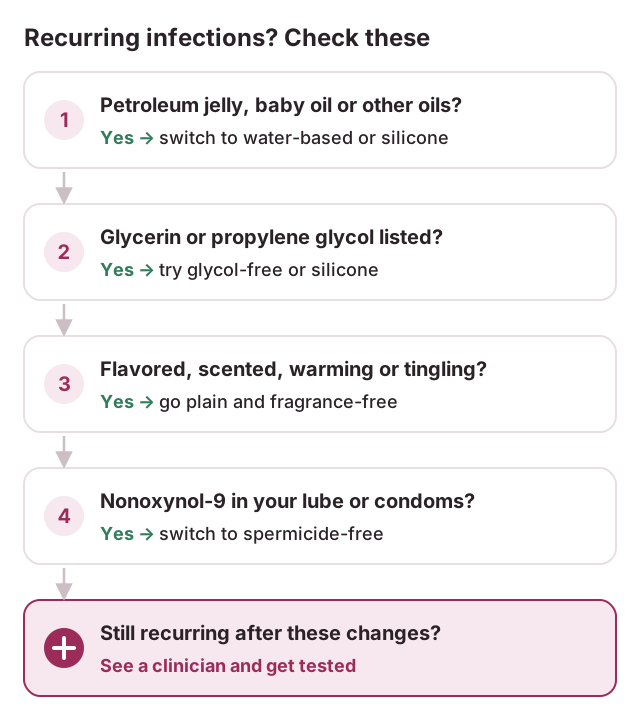
The Canadian Family Physician review recommends silicone- or water-based lube for people with recurrent vaginal infections or irritation. In practice, that means:
- Drop petroleum jelly, baby oil and other oils for anything internal.
- Read the list for glycols (glycerin, propylene glycol, PEG-8) and parabens, which the review suggests avoiding if you get frequent infections.
- Skip extras: fragrance, flavors made with sugars, warming or tingling agents, numbing agents, chlorhexidine and nonoxynol-9 are all on the review’s avoid list.
- Check the numbers if a water-based brand publishes them. The review suggests an osmolality under 380 mOsm/kg, or under 1,200 if options are limited.
- Keep simple notes: which lube, which date, any symptoms. A pattern over a few months is more useful to you and your clinician than a hunch.
Don’t forget what the lube touches, either. Toys that aren’t cleaned well between uses are worth ruling out; see our guide to cleaning sex toys. And check that your choice still works with your condoms and toys in the Lube Compatibility Checker.
When to see a clinician
Self-diagnosis is unreliable here. The CDC notes that people who’ve had a yeast infection diagnosed before aren’t necessarily better at recognizing the next one, and that unnecessary over-the-counter treatment can delay treatment of whatever is actually going on. See a gynecologist, primary care clinician or sexual health clinic if:
- your symptoms persist after an over-the-counter yeast treatment, or come back within two months of treatment (the CDC says both warrant an exam and testing);
- you’ve had three or more symptomatic yeast infections in under a year, which the CDC defines as recurrent; testing (often a culture) can confirm the diagnosis and identify less common Candida species;
- you keep getting UTIs, which the NHS defines as two in six months or three in a year;
- you have UTI symptoms plus a fever or shivering, pain in your lower belly or in your back just under the ribs, or blood in your pee, or you’re pregnant, were assigned male at birth, or haven’t improved within 48 hours of starting treatment. The NHS advises getting seen urgently in these cases.
Frequently asked questions
Can lube cause infections?
Not usually by itself. The links with research behind them are specific: petroleum jelly with BV, oils with yeast, spermicide with UTIs, and possibly very concentrated water-based lube with BV in some groups. A plain silicone or water-based lube without extras is the low-risk default.
Can lube cause irritation?
Yes. Concentrated formulas, warming agents, fragrance and preservatives can all sting or itch, and that irritation is easy to mistake for an infection. Our guide to why lube burns walks through the culprits and what to do right away.
Is silicone lube better if I get yeast infections?
It’s a reasonable switch. Silicone lube contains no glycols or sugars, and the 2025 review recommends silicone- or water-based lube for recurrent infections. Just check that it works with your toys, since silicone lube can damage some silicone toys; our lube guide explains.
Should I stop using lube if I keep getting BV?
Probably not. Going without means more friction, and the evidence points at specific products rather than lube in general. Stop using petroleum jelly or oils, choose a plain lube with a published low osmolality if you can, and get tested if BV keeps returning.
Sources
- Obstetrics & Gynecology (2013): Intravaginal practices and risk of bacterial vaginosis and candidiasis infection among a cohort of women in the United States
- Sexually Transmitted Diseases (2025): Bacterial vaginosis incidence following a single hyperosmolal vaginal lubricant exposure
- Canadian Family Physician (2025): Approach to lubricant use for sexual activity
- CDC: Vulvovaginal candidiasis, STI Treatment Guidelines
- NHS: Urinary tract infections (UTIs)
Spotted an error or something out of date? Email [email protected] and we’ll take a look.
More guides

Guide · Toy Safety & Care
Body-Safe Toy Materials: What to Choose and What to Avoid
Not every material is equally safe. Learn which materials are non-porous and easy to clean, and which ones to avoid.
Updated

Guide · Toy Safety & Care
How to Buy Sex Toys Discreetly: Packaging, Billing and Delivery
What discreet shipping really looks like, what shows up on your bank statement, and how to keep emails, deliveries and gifts private in a shared home.
Updated