Mismatched Libido: What to Do When Your Sex Drives Differ
Mismatched libido is something couples can work on together. How responsive desire works, how to talk without blame, what affects libido and when to get help.

A mismatch in sex drive doesn’t mean your relationship is broken, and it doesn’t mean one of you is normal and the other isn’t. It’s a difference you can work on together. What helps most is understanding how desire actually works (desire can show up after things get started, not only before), talking about it without blame, making room for intimacy that doesn’t depend on both of you being spontaneously in the mood, and ruling out health factors that can quietly flatten libido. If every conversation turns into a fight, a certified sex therapist can help.
Why sex drives drift apart
Two people rarely want sex at exactly the same rhythm, and the gap often gets more noticeable once a relationship settles in. That isn’t a sign that something’s wrong with you. Rosemary Basson, a sexual medicine researcher at the University of British Columbia, notes that spontaneous desire, the out-of-the-blue kind, tends to decrease with age and commonly increases with a new relationship. So the early months, when neither of you could keep your hands off the other, are a poor yardstick for year seven.
Life piles on, too. Stress, exhaustion, a new baby, a health scare, a medication change: all of these can shift one partner’s libido without touching the other’s. And sometimes the mismatch isn’t about frequency at all, but about the kind of sex, the timing or what sex means to each of you.
Spontaneous vs responsive desire
This idea can change the whole conversation. Basson developed a model of sexual response, based on women in long-term relationships, in which desire doesn’t always come first.
- Spontaneous desire arrives on its own. You find yourself wanting sex, then you seek it out, then arousal follows.
- Responsive desire starts from somewhere more neutral. Basson describes a starting point of “sexual neutrality, but with positive motivation”: you’re not feeling lustful, but you have a reason to be open, such as wanting to feel close or to express love. If you’re willing to focus on touch and stimulation, arousal builds, and then, in her words, continued stimulation lets excitement and pleasure intensify, “triggering desire for sex itself.” Outcomes that feel good, emotionally and physically, make you more motivated next time.
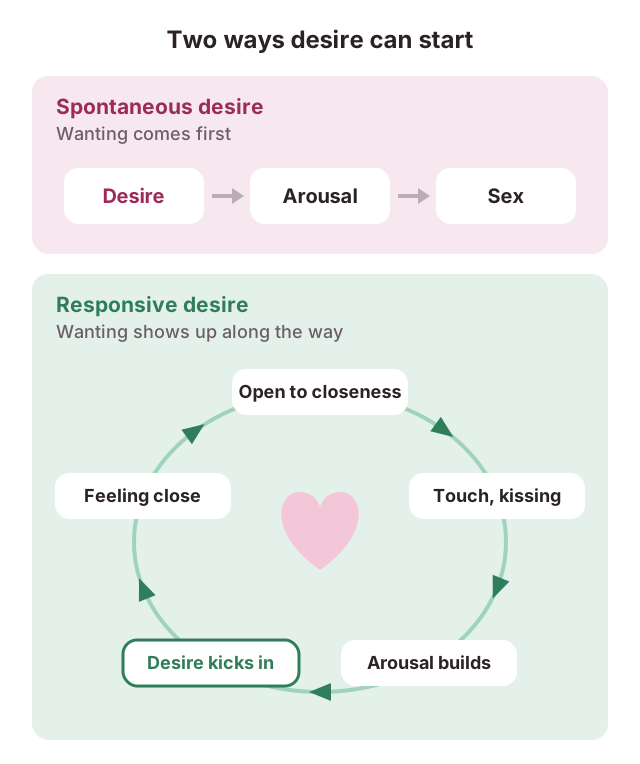
The model was written about women, but you don’t need to be one for it to sound familiar. Here’s why it matters for a mismatch:
- For the partner who wants sex less often: not feeling desire beforehand doesn’t mean you don’t want your partner or won’t enjoy it. It may mean your desire is the responsive kind, and it needs the right context and a reason to start.
- For the partner who wants sex more often: a partner who rarely initiates isn’t necessarily rejecting you. Waiting for them to be spontaneously in the mood may simply mean waiting for something that, for them, doesn’t arrive first.
What affects your libido?
Before you treat a mismatch as purely a relationship issue, check the health side. The NHS lists these possible reasons for a low sex drive:
| Area | What can lower libido |
|---|---|
| Relationship | Relationship problems |
| Mood | Stress, anxiety or depression |
| Sexual problems | Erectile dysfunction, or vaginal dryness that makes sex uncomfortable |
| Life stage | Pregnancy and having a baby; lower hormone levels with age, particularly around menopause |
| Medicines | Some blood pressure medicines and antidepressants; hormonal contraception such as the pill, patch or implant |
| Alcohol | Drinking too much |
| Long-term conditions | Heart disease, diabetes, an underactive thyroid or cancer |
The NHS suggests seeing a doctor if you’re worried about your sex drive, if you think a medicine or contraceptive is the cause, or if your sex drive hasn’t come back after pregnancy. If you suspect a medication, ask about alternatives rather than stopping it on your own. Treatment depends on the cause and can include relationship counseling, treatment for erection problems or vaginal dryness, hormone therapy for menopause, or talking therapy or medicine for anxiety or depression.
One cause deserves its own line: if sex hurts, it’s no mystery why desire drops. Our guides to painful sex after menopause and vaginal moisturizer vs lube cover what helps.
How to talk about mismatched libido without blame
The aim of the first conversation isn’t to fix anything. It’s to understand each other well enough to try something.
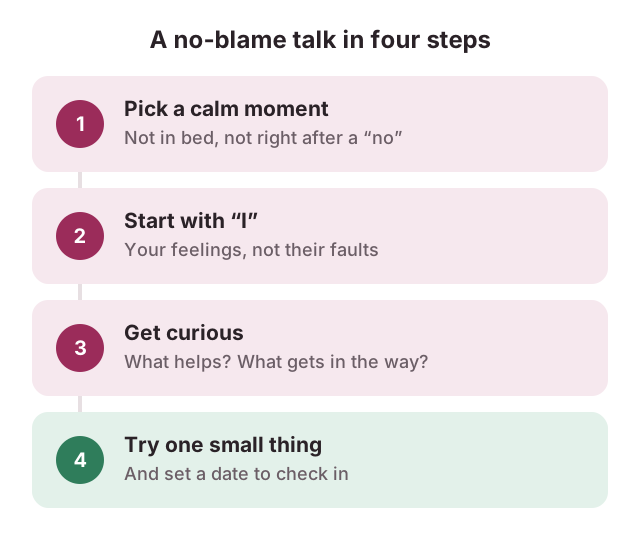
- Pick a calm moment. Not in bed, not straight after one of you turned the other down, not in the middle of an argument about something else. A walk works well; so does a quiet evening with phones away.
- Start with “I.” Talk about your own experience and what you value. “I miss feeling close to you” lands very differently from “You never want sex.” If you’re the lower-desire partner: “I love you, and when I feel pressure it gets harder for me to want sex” is honest without being an accusation.
- Get curious. Ask questions you don’t know the answer to. What makes you feel close? What gets in the way: being tired, feeling touched-out, the kids down the hall? What does sex give you, whether that’s release, reassurance, fun or connection? Is it the frequency that bothers you, or the kind of sex?
- Try one small thing, and set a check-in. Pick one experiment for the next two weeks, then talk again. Small and specific beats a grand plan.
A few things to leave out: keeping score, ultimatums, and comparing yourselves to other couples or to statistics you saw online. Nobody wins a negotiation about desire.
Should you schedule sex?
It can sound unromantic. Surely sex should be spontaneous? But if one of you has mostly responsive desire, waiting for spontaneity can mean waiting a long time. Scheduling doesn’t schedule the desire; it schedules the context where responsive desire has a chance to show up.
Make it work with a few ground rules:
- Book time for intimacy, not a guaranteed outcome. The date is for being close. Sex may follow, and it may not.
- Let either of you downshift. If one of you isn’t into it that night, switch to a massage or a cuddle rather than canceling.
- Protect it. Treat it like any other date: no laundry, no email, a door that closes.
- Revisit it. If the calendar starts to feel like a chore for either of you, that’s useful information. Adjust it rather than grinding on.
Broaden what counts as intimacy
If the only thing that “counts” is intercourse, every no feels like a rejection and every yes carries the pressure of going all the way. Widening the menu takes the pressure down for both of you. Options include:
- kissing just for the sake of kissing;
- massage with no expectation attached;
- showering or bathing together;
- mutual masturbation, oral sex or using toys together;
- sleeping skin to skin;
- flirting during the day, by text or in person.
One useful exercise: each of you privately writes a yes, no and maybe list, then you compare notes. If toys end up on the maybe list, our guide to talking with your partner about toys can help, and our lube guide covers the practical side. Solo sex has a place here too. For some couples, the higher-desire partner taking care of themselves is part of the solution, not a betrayal; talk about what feels right for you both.
When to see a sex therapist
Consider professional help if:
- your conversations about sex keep turning into fights or long silences;
- one of you feels pressured most of the time, or the other feels rejected most of the time;
- the mismatch is causing real distress for either of you;
- desire changed suddenly, or alongside pain, erection problems or a medication change (see a doctor too);
- past trauma is part of the picture.
AASECT, the American Association of Sexuality Educators, Counselors and Therapists, certifies sex therapists who are licensed mental health professionals specializing in sexual issues and concerns. Its referral directory lets you search by state and filter for therapists, counselors or educators. The NHS also lists relationship counseling as an option for low libido linked to relationship problems.
If menopause is part of your story, see our guide to sex and menopause as well.
Frequently asked questions
Is mismatched libido normal in a marriage?
Two people rarely want sex at exactly the same rhythm, and a mismatch doesn’t mean your marriage is in trouble. Spontaneous desire tends to fade with age and to surge in new relationships, so a gap that appears a few years in is unsurprising. What matters is how you handle it together.
What affects your libido?
Relationship problems, stress, anxiety and depression, sexual problems such as erectile dysfunction or vaginal dryness, pregnancy, menopause and aging, some medicines and hormonal contraceptives, heavy drinking, and long-term conditions such as diabetes or heart disease can all lower libido. A doctor can help you work out whether something on that list is involved.
What’s the difference between responsive and spontaneous desire?
Spontaneous desire comes first: you want sex, then you go looking for it. Responsive desire starts from feeling neutral but open to closeness, and the wanting shows up once touch and arousal are underway. Neither is better, and the same person can experience both.
Can a relationship survive mismatched libido?
Yes, there’s no reason it can’t, but it usually takes more than waiting it out. In our view, your best shot comes from talking about it without blame, making room for intimacy that isn’t all-or-nothing and checking for health causes. If you’re stuck, a certified sex therapist can help you both get unstuck.
Sources
Spotted an error or something out of date? Email [email protected] and we’ll take a look.
More guides

Guide · Toy Safety & Care
Body-Safe Toy Materials: What to Choose and What to Avoid
Not every material is equally safe. Learn which materials are non-porous and easy to clean, and which ones to avoid.
Updated

Guide · Toy Safety & Care
How to Buy Sex Toys Discreetly: Packaging, Billing and Delivery
What discreet shipping really looks like, what shows up on your bank statement, and how to keep emails, deliveries and gifts private in a shared home.
Updated