Kegel Balls and Weights for Beginners: How to Use Them Safely
How to use Kegel balls and weights, what the research shows, how to clean them, who should check first, and how they compare with app-connected trainers.

Kegel balls and Kegel weights are smooth weighted pieces you put in your vagina and hold in place with your pelvic floor muscles, which turns ordinary Kegels into resistance training. To start, use the lightest weight, practice lying down for a few minutes a day, and move up only when that feels easy. They can help with bladder leaks, but the research says they work about as well as plain pelvic floor exercises, not better.
If you’ve never done a Kegel, learn the basic squeeze first with our Kegel exercises guide. A weight is only useful once you know which muscles you’re using.
Kegel balls vs. Kegel weights (and Ben Wa balls)
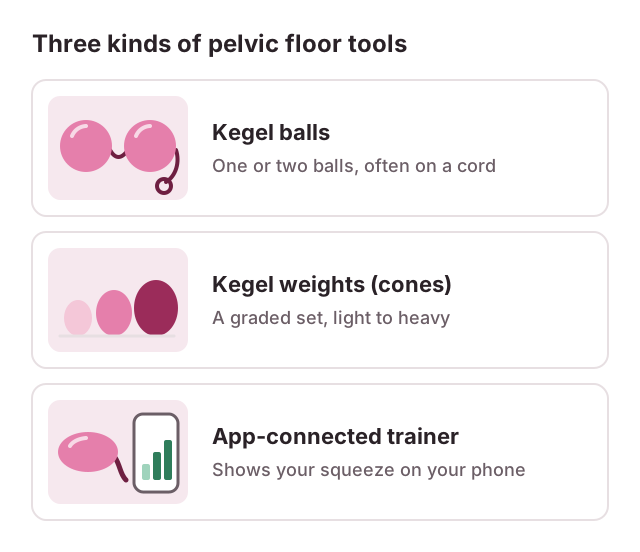
Shops use these names loosely, so here’s what they usually mean:
- Kegel weights, which clinicians call vaginal cones, come as a graded set from light to heavy. You hold one in place, and when that gets easy you move to the next one up.
- Kegel balls are round, come singly or in pairs, and often hang from a cord for removal. Some are sold in graded weights, too.
- Ben Wa balls is an older name you’ll still see, often on small balls sold for pleasure rather than training.
- App-connected trainers add no weight at all. A sensor measures your squeeze and shows it on your phone, which is a form of biofeedback.
Do Kegel balls and weights actually work?
For bladder leaks, modestly, and about as well as Kegels without them.
The best summary is a 2013 Cochrane review of weighted vaginal cones for stress urinary incontinence, the kind of leak that happens when you cough, sneeze or exercise. It pooled 23 small trials with 1,806 women. Cones beat no active treatment, though the reviewers note that none of the comparison groups truly got nothing. Against pelvic floor training without weights, or electrical stimulation, there was little evidence of a difference, and adding cones to regular training showed no clear extra benefit. The reviewers called their conclusions tentative and said cones “could be offered as one treatment option, if women find them acceptable.”
Acceptability is a real issue. About one in five women using cones alone dropped out of treatment (20%), almost the same share as those doing pelvic floor training without weights (21%). The few trials that recorded reasons listed motivation problems, unpleasantness, discomfort, bleeding and prolapse.
Kegel balls specifically have less research. One randomized trial in Spain gave 70 women with urinary incontinence the same home routine, Kegels twice a day, five days a week for six months, with or without vaginal balls. Both groups improved. The ball group improved sooner on a leakage questionnaire and also improved on a pad test, which the other group didn’t. Four women in the ball group reported mild, short-lived side effects, compared with one in the other group. It was a single, unblinded trial, so treat it as encouraging rather than settled.
The NHS sums it up fairly: cones may help with stress or mixed incontinence, and some women find them uncomfortable or unpleasant. The trials we found measured bladder leaks; claims about sexual benefits on the box have far less behind them.
How to use Kegel balls or weights for the first time
Read the instructions that came with your set first. Products differ, and the manufacturer’s directions beat any general guide, including this one. Then:
- Wash it in warm, soapy water and rinse well.
- Pick the lightest weight. In clinic programs, women are taught to find the heaviest cone they can hold while standing and moving. Without a clinician guiding you, starting light is the cautious choice.
- Add a little water-based lube to make insertion easier. It’s safe with every toy material; see our lube guide.
- Lie on your back with your knees bent and insert it until it sits comfortably, with any removal cord outside.
- Squeeze and lift around it. Hold for 3 seconds, relax for 3 seconds, and repeat 10 times. Cleveland Clinic notes that lying down is easier at first if your muscles are weak.
- Keep the first sessions short. Cleveland Clinic suggests a few minutes a day, then gradually more time.
- Relax and remove it by gently pulling the cord, then wash and dry it.
How to progress
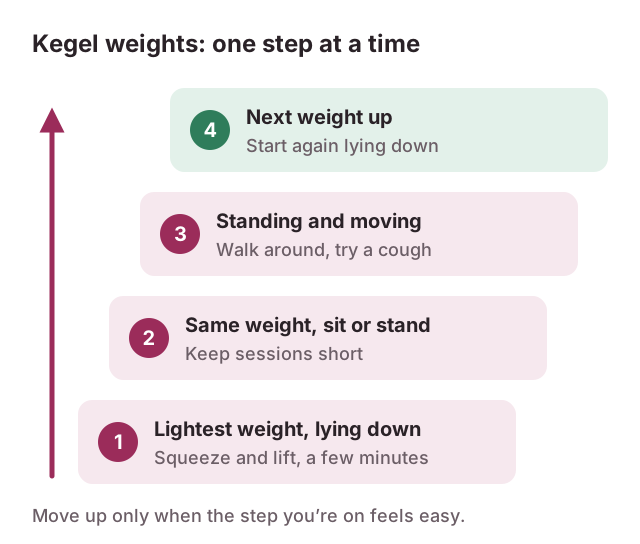
Move up one rung at a time:
- Lightest weight, lying down, with active squeezes.
- Same weight, sitting or standing.
- Same weight while standing and moving: walking around the room, a cough or two. That mirrors the cone trials, where women moved to the next cone once they could hold one while standing, moving and coughing.
- The next weight up, starting again lying down.
How long per session? The cone trials typically asked for two 15-minute sessions a day after initial training, for a month or more. That’s the protocol that was studied, not a rule for every product. Elvie’s instructions for its app-connected trainer, for example, advise against exercising with it for more than 15 minutes in 24 hours, or leaving it in for more than an hour. Follow your product’s directions, and don’t assume more is better: Cleveland Clinic warns that doing too many Kegels can make your muscles too tense.
How to clean Kegel balls and weights
- Before and after every use, wash with warm, soapy water and rinse thoroughly.
- Dry it completely before you put it away.
- Check the care instructions for your material. Elvie, for instance, says not to boil its trainer, use harsh cleaners, or put it in a sterilizer or dishwasher. Other products may allow boiling. Don’t guess.
- Don’t share. Elvie describes its trainer as a single-user product, and that’s a good rule for any internal device.
- Replace anything cracked or torn, including the cord.
For material-by-material cleaning, see how to clean sex toys; for what to buy in the first place, our guide to body-safe materials explains why nonporous materials are easier to keep clean.
Who should skip Kegel weights or check with a clinician first?
Weights add load to muscles that may not need it. Hold off and talk to a clinician if any of these apply:
- Pelvic pain, pain with sex, or trouble relaxing your pelvic floor. Some pelvic floors are too tight rather than too weak, and extra squeezing can make that worse. A pelvic floor physical therapist is the right first stop.
- Pregnancy. Elvie says there’s no technical reason its trainer can’t be used in pregnancy but still recommends checking with a healthcare professional first. Ask your ob-gyn or midwife.
- The weeks after giving birth. Elvie’s instructions say not to use its trainer within six weeks of giving birth. Wait until your clinician clears you.
- An infection or unusual discharge. Elvie says not to use its device during an active urinary infection, because it may cause pain, tightness or reinfection, and to see a specialist first if you have abnormal discharge or frequent urinary infections. Get treated and wait until symptoms clear.
- Prolapse. Elvie advises seeing a pelvic floor specialist first if you have severe prolapse, and prolapse was one of the reasons women in the cone trials stopped. If you’ve been told you have one, get assessed before adding weight.
- An IUD. We didn’t find clinical guidance either way on Kegel weights and IUDs, so ask the clinician who placed yours before you start.
- Recent pelvic or vaginal surgery. Ask your surgeon when it’s safe.
If you’re past menopause, our guide to pelvic floor exercises after 50 covers what changes and when to see a specialist.
Kegel balls vs. weights vs. app-connected trainers
| Kegel balls | Kegel weights (cones) | App-connected trainers | |
|---|---|---|---|
| How it challenges you | You hold it in place | You hold it in place, then move up to heavier weights | No added weight; you squeeze against a sensor |
| Feedback | The feeling of it slipping | The feeling of it slipping, plus a clear next step | A live readout on your phone |
| Evidence we found | One small randomized trial | A Cochrane review of 23 small trials | NHS: not much good evidence that biofeedback adds a significant benefit, though it may help motivation |
| What you need | Nothing else | Nothing else | A charged device and a compatible phone |
Which to choose? If you can clearly feel your squeeze and want resistance, graded weights give you the most obvious way to progress. If you’re not sure you’re squeezing the right muscles at all, feedback helps more than weight, and one session with a pelvic floor physical therapist beats any gadget for that. Either way, the exercise does the work; the Cochrane review found no clear difference between cones and plain pelvic floor training.
Some of these devices can be bought with pre-tax money. See whether a pelvic floor trainer is HSA or FSA eligible.
Frequently asked questions
Are Kegel balls safe?
For most people, used as directed, yes. In the randomized trial of vaginal balls, side effects were mild and short-lived. Choose a body-safe, nonporous product, clean it every time, and skip it if you have pelvic pain, an infection, prolapse symptoms, or have given birth in the last six weeks until a clinician says it’s fine.
How long should you wear Kegel balls?
Start with a few minutes a day and build gradually. The cone trials used two 15-minute sessions a day, while some manufacturers set lower limits, so follow your product’s instructions. Nothing we found suggests wearing them all day.
Can you walk around with Kegel balls in?
Eventually, yes. In cone programs, standing and moving around with the weight in place is the goal, not the starting point. Begin lying down, then sitting or standing, and add walking once that feels easy.
Kegel balls or Kegel weights: which is better for beginners?
We found no head-to-head research. Graded weights give you a clear, step-by-step way to progress, so you always know what “next” looks like. Whichever you choose, start with the lightest option.
Are Ben Wa balls the same as Kegel balls?
Sometimes. “Ben Wa balls” is an older term often used for small balls sold for pleasure, while “Kegel balls” are usually sold for training, sometimes in graded weights. Check the material, weight and removal cord before using either for exercise.
Sources
- Cochrane Database of Systematic Reviews: Weighted vaginal cones for urinary incontinence (Herbison and Dean, 2013)
- Neurourology and Urodynamics: Effect of vaginal spheres and pelvic floor muscle training in women with urinary incontinence (Porta-Roda et al., 2015)
- NHS: Urinary incontinence, non-surgical treatment
- Cleveland Clinic: Kegel exercises
- Elvie: Elvie Trainer instructions for use (manufacturer)
Spotted an error or something out of date? Email [email protected] and we’ll take a look.
More guides

Guide · Toy Safety & Care
Body-Safe Toy Materials: What to Choose and What to Avoid
Not every material is equally safe. Learn which materials are non-porous and easy to clean, and which ones to avoid.
Updated

Guide · Toy Safety & Care
How to Buy Sex Toys Discreetly: Packaging, Billing and Delivery
What discreet shipping really looks like, what shows up on your bank statement, and how to keep emails, deliveries and gifts private in a shared home.
Updated