Is a Pelvic Floor Trainer HSA or FSA Eligible? How to Claim It
Pelvic floor trainers can qualify for HSA or FSA money when they treat a medical problem. How the IRS rules work, when you need an LMN, and how to claim.

Often, yes. HSA and health FSA money can pay for a pelvic floor trainer when you’re buying it to treat a medical problem, such as bladder leaks, rather than for general fitness. Some sellers list certain trainers as fully eligible, others ask for a letter of medical necessity (LMN), and your plan administrator has the final say. So check your plan’s rules before you buy, and keep every receipt.
One thing first: you don’t need a device to train your pelvic floor. Plenty of people do well with plain Kegels and a timer, like our free Kegel Trainer. If you do want a trainer or a set of Kegel weights, here’s how to pay for it with pre-tax money.
How HSA and FSA eligibility works
HSAs and health FSAs pay tax-free for “medical care” as the tax code defines it. IRS Publication 502 spells that out: medical expenses are “the costs of diagnosis, cure, mitigation, treatment, or prevention of disease, and for the purpose of affecting any part or function of the body,” including “equipment, supplies, and diagnostic devices needed for these purposes.”
Then comes the line that matters most for a Kegel trainer. Medical care has to be “primarily to alleviate or prevent a physical or mental disability or illness,” and it doesn’t include expenses that are “merely beneficial to general health.”
A pelvic floor trainer sits right on that line, because it’s exercise equipment. The IRS is blunt about exercise: workouts for general health don’t count, “even if recommended by a doctor.” Yet the same IRS FAQ says a gym membership can count when it’s bought solely to treat a specific disease diagnosed by a physician, or as part of a prescribed physical therapy plan for an injury. Purpose decides it.
In September 2026 the IRS added an answer about wearable devices that track bodily functions, such as a band, ring, patch or sensor. A device like that isn’t a medical expense just because it tracks health data. It is one when you buy and use it “primarily to assist in the diagnosis, cure, mitigation, treatment, or prevention of a specific disease.” The facts that point that way include a recommendation from a medical practitioner, your symptoms or diagnosis, and how the information is used. App subscriptions and accessories follow the same rule, and “a generalized desire to monitor or improve health is not sufficient.”
That FAQ doesn’t name pelvic floor trainers. Still, it’s the closest official guidance for an app-connected one, and we read it as a clear signal: a clinician’s recommendation tied to a diagnosis carries real weight.
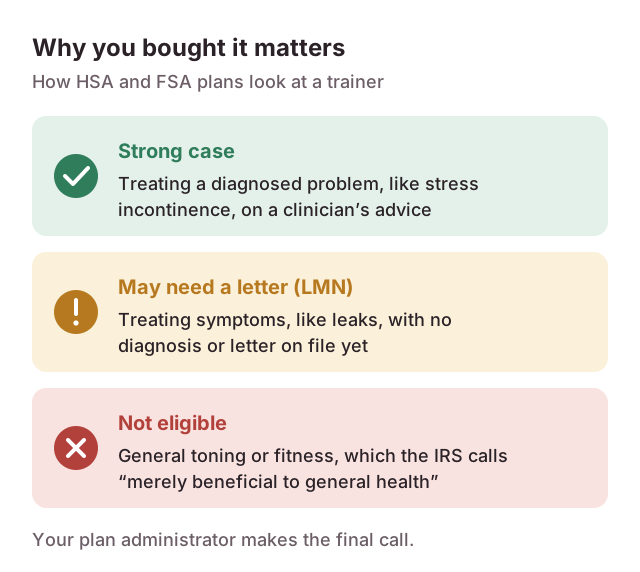
The device’s label can help, too. Some trainers are FDA-cleared with a medical indication. Perifit Care+, for example, was cleared in December 2023 as an over-the-counter Class II perineometer “designed to treat stress, mild-moderate urge and mixed urinary incontinence in women.” You can look up any device in the FDA’s 510(k) database. A clearance doesn’t make your purchase eligible on its own, but it’s easy evidence that the device is meant for treatment.
“Eligible” vs. “eligible with an LMN”: what’s the difference?
Shopping sites and benefit administrators sort products into rough buckets: accepted with a receipt, accepted only with a letter of medical necessity, or not accepted. Those labels are business categories, not IRS terms, and two companies can put the same product in different buckets.
Pelvic floor trainers show this well. When we checked in November 2026, HSA Store listed both the Perifit Care+ and Intimina’s Laselle weighted exerciser as “100% HSA eligible.” Perifit’s own FSA/HSA help page, meanwhile, says pelvic health devices are eligible but require an LMN, and it recommends checking with your FSA or HSA provider before you buy. Neither is a guarantee. A retailer listing tells you how that store classifies the product; your plan administrator decides whether your claim is valid.
What is a letter of medical necessity?
An LMN is a short letter from a clinician saying you need a specific item to treat a diagnosed condition. There’s no IRS form for it, and plans differ on what they want. What the letter should show lines up with the facts the IRS says matter: your diagnosis or symptoms, a practitioner’s recommendation, and how the device treats that condition.
How to get an LMN for a pelvic floor trainer
- Ask your plan first. Find out whether it wants an LMN for a pelvic floor trainer, whether it has its own form, and how long a letter stays valid.
- Book the right appointment. Ask the clinician treating the problem: your primary care doctor, gynecologist or urologist, or a pelvic floor physical therapist if your plan accepts letters from therapists. The visit itself is a medical expense, so your HSA or FSA can cover the copay.
- Bring specifics. Say what’s happening (leaking when you cough or run, say, or sudden urges you can’t hold), how long it’s been going on, and what kind of device you’re considering.
- Ask for precise wording. A letter that names the condition and the device type, such as a pelvic floor trainer with biofeedback for stress urinary incontinence, leaves less room for a reviewer to guess.
- File a copy with the receipt. You may need both again later.
Card at checkout or pay and claim?
You have two ways to spend the money, and the paperwork is similar either way.
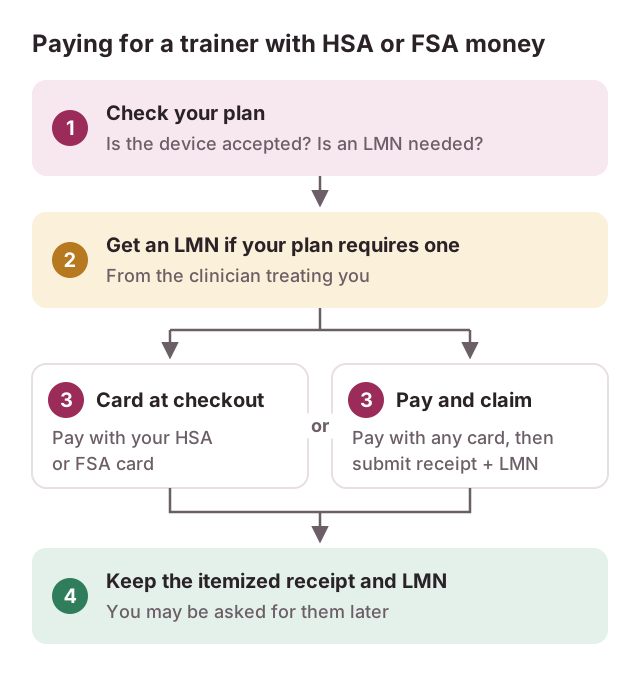
Pay with your HSA or FSA card. If the checkout accepts it, the money comes straight from your account. That doesn’t end your responsibility. For an HSA, the IRS says you must keep records showing the money went only to qualified medical expenses that weren’t paid from another source; you don’t send them with your tax return, but you need them if asked. For an FSA, card purchases that meet certain IRS substantiation methods may need no extra paperwork. If yours doesn’t, expect a request for the receipt and, if your plan requires one, the LMN.
Pay and claim. Pay with any card, then submit the itemized receipt (plus the LMN, if your plan wants one) to your administrator. A health FSA needs a written statement from an independent third party showing the expense and its amount, which in practice means that itemized receipt, plus your statement that no other coverage reimbursed it.
A declined card at checkout isn’t the last word. Perifit’s help page, for one, suggests paying with a personal card and then submitting the receipt, and the LMN if needed, to your plan.
Timing differs between the two accounts:
- HSA: you can reimburse yourself for qualified expenses incurred any time after you opened the account, and you don’t have to take the money out in the same year.
- FSA: the money is generally use-it-or-lose-it. Your plan may offer a grace period of up to 2½ months or a limited carryover into next year, but not both. An FSA also can’t pay you back in advance for something you haven’t bought yet. If your plan year ends December 31 with no grace period or carryover, a trainer bought in December counts; one ordered in January doesn’t.
Does insurance cover a trainer or pelvic floor therapy?
Insurance and HSAs or FSAs are separate questions. Your HSA or FSA spends your own pre-tax money; insurance decides whether the plan pays. Don’t assume it will pay for an at-home device.
Medicare’s national coverage policy on biofeedback for urinary incontinence shows how insurers can draw the line. It covers biofeedback for stress or urge incontinence in cognitively intact patients who haven’t improved after a documented four-week trial of an ordered pelvic muscle exercise plan. It also says plainly that “home use of biofeedback therapy is not covered.” Private plans write their own policies, so the only way to know is to ask.
In our view, pelvic floor physical therapy is the more useful thing to ask about. A therapist can check that you’re squeezing the right muscles and tell you whether a device would add anything. Questions worth putting to your insurer:
- Is pelvic floor physical therapy covered under my outpatient therapy benefit?
- Do I need a referral or prior authorization?
- Is there a limit on visits, and what will I pay per visit?
- Is the therapist I want in network?
Whatever insurance leaves you to pay, such as copays, coinsurance or the deductible, can generally come from your HSA or FSA. IRS Publication 502 counts therapy “received as medical treatment” as a medical expense.
Frequently asked questions
Is Perifit HSA eligible?
One retailer says so: in November 2026, HSA Store listed the Perifit Care+ as “100% HSA eligible,” and the device is FDA-cleared to treat urinary incontinence. Perifit’s own help page says pelvic health devices need an LMN. Your plan administrator makes the call, so check with them before buying, especially from a general retailer.
Can I use my FSA for a Kegel trainer?
Yes, if your plan accepts it as medical care, which usually means it’s for a diagnosed problem such as leaking. Expect to submit an itemized receipt, and possibly an LMN. Watch your plan year’s deadline, because FSA money you don’t use may be forfeited.
Is a pelvic floor trainer covered by insurance?
Don’t count on it. Medicare’s biofeedback policy, for example, excludes home use, and private plans set their own rules. Supervised pelvic floor physical therapy is worth asking your insurer about, and your HSA or FSA can usually cover what’s left after insurance.
Do I need a letter of medical necessity for a pelvic floor trainer?
It depends on your plan. Some accept an itemized receipt alone; others want an LMN as well. Ask before you buy, so you can get the letter at the same appointment where you discuss your symptoms.
Are Kegel weights HSA eligible?
The same purpose test applies. In November 2026, HSA Store listed Intimina’s Laselle weighted exerciser as “100% HSA eligible,” but your administrator still decides. If you’re new to weights, read our beginner’s guide to Kegel balls and weights first, and start with the basics in our Kegel exercises guide.
Sources
- IRS: Publication 502, Medical and Dental Expenses
- IRS: Publication 969, Health Savings Accounts and Other Tax-Favored Health Plans
- IRS: Frequently asked questions about medical expenses related to nutrition, wellness and general health
- FDA: 510(k) premarket notification K231780 (Perifit Care+)
- CMS: National Coverage Determination 30.1.1, Biofeedback Therapy for the Treatment of Urinary Incontinence
Spotted an error or something out of date? Email [email protected] and we’ll take a look.
More guides

Guide · Toy Safety & Care
Body-Safe Toy Materials: What to Choose and What to Avoid
Not every material is equally safe. Learn which materials are non-porous and easy to clean, and which ones to avoid.
Updated

Guide · Toy Safety & Care
How to Buy Sex Toys Discreetly: Packaging, Billing and Delivery
What discreet shipping really looks like, what shows up on your bank statement, and how to keep emails, deliveries and gifts private in a shared home.
Updated