Kegel Exercises for Men: A Step-by-Step Guide (With Pictures)
How men can find their pelvic floor muscles, a starter Kegel routine, what research shows for erections and after-pee dribbling, and mistakes to avoid.

Kegel exercises for men are squeezes of the pelvic floor, the muscles you’d use to stop yourself peeing or passing gas. Done right, the base of the penis pulls in slightly and the testicles lift. Start with 10 five-second squeezes, three times a day, and give it six to eight weeks. In one small randomized trial, men with erectile dysfunction who trained these muscles improved more than men who got only lifestyle advice, and a strong squeeze after peeing helped stop after-dribble.
Men have a pelvic floor too: a hammock of muscle across the base of the pelvis. It supports the bladder and bowel, helps you hold in urine and gas, and plays a part in erections and ejaculation. Our beginner’s Kegel guide covers the basics for everyone; this one is about the details that are different for men.
What can Kegels do for men?
Cleveland Clinic lists several benefits of a stronger pelvic floor for men:
- less leaking of urine or stool
- help managing prostate pain and swelling from prostatitis or an enlarged prostate (BPH)
- support for erections, because these muscles help control blood flow to the penis
- more control over when you ejaculate, and a better orgasm
- better bladder control after prostate surgery or other prostate procedures
The research behind each of those varies a lot, as you’ll see below. The muscles are worth training either way.
How to find your pelvic floor muscles (for men)
You can’t see these muscles, so you find them by feel. Try any of these cues from Cleveland Clinic and the Dorey trial:
- Imagine stopping your pee midstream. Imagine, rather than actually doing it on the toilet.
- Imagine holding in gas. The squeeze that stops you passing wind uses the same muscles.
- Feel for the lift. Cleveland Clinic describes these as the muscles that pull your scrotum up toward your body.
- Use a mirror. Standing in front of one, a correct squeeze should make the base of your penis draw in toward your belly and your testicles rise. That’s the check the physiotherapist in the Dorey trial taught.
- Check by touch, if you’re comfortable with it. Cleveland Clinic suggests inserting a finger into your rectum and squeezing; you should feel the muscles tighten, relax and move up around your finger.
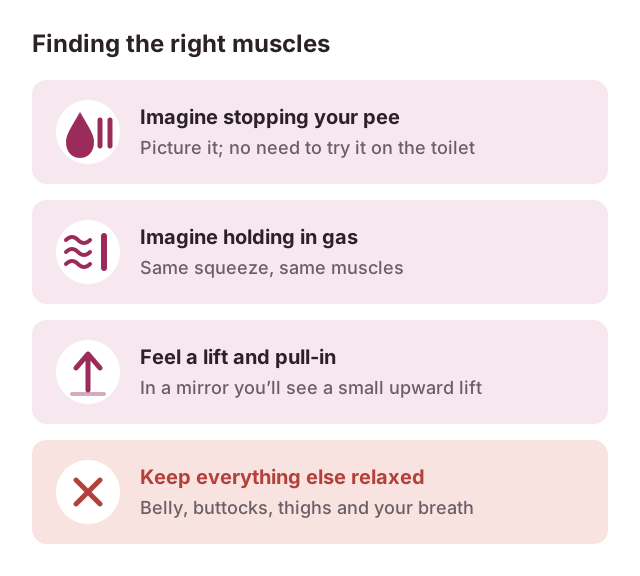
Everything else should stay relaxed: your belly, buttocks and thighs. If you can’t tell if you’re doing it right after a couple of weeks, a pelvic floor physical therapist can check for you, sometimes using biofeedback.
A starter Kegel routine for men
This is Cleveland Clinic’s routine, with a few additions from the program used in the Dorey trial.
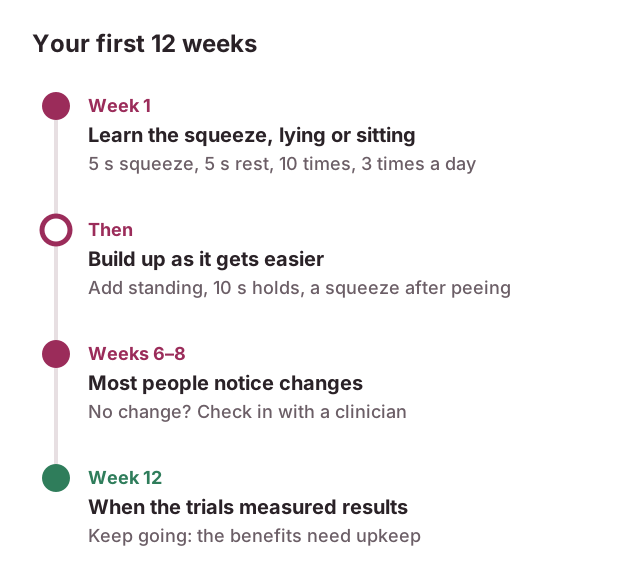
- Get comfortable. Sit with your feet flat and your back supported, or lie on your back or side.
- Squeeze and lift your pelvic floor for about 5 seconds.
- Relax fully for 5 seconds.
- Repeat 10 times. That’s one session. Count out loud so you don’t hold your breath.
- Do three sessions a day: morning, afternoon and evening. Stop if your muscles get tired.
- Build up gradually to 10-second squeezes with 10-second rests.
Once that feels routine, the Dorey program adds three things worth copying:
- Change positions. Men in the trial did their strongest squeezes lying down, sitting and standing, morning and evening.
- Lift while you walk. They were taught to lift the pelvic floor to about half effort while walking.
- Squeeze after you pee. A strong squeeze once you’ve finished helps push out the last drops (more on that below).
Can Kegels help with erectile dysfunction?
They might. There’s one randomized trial behind that, though it’s small.
In the Dorey trial, 55 men with erectile dysfunction (median age 59) were randomly assigned to either pelvic floor exercises plus lifestyle advice, or lifestyle advice alone. The exercise group had five weekly 30-minute sessions with an experienced physiotherapist, using biofeedback, plus daily exercises at home. After three months, they scored 6.74 points higher on the erectile function part of a standard questionnaire than the advice-only group. The advice-only men then switched to the exercises and improved too.
By six months, across everyone in the study:
- 40% had regained normal erectile function
- 34.5% had improved
- 25.5% hadn’t improved
Keep the limits in mind. That’s one trial of 55 men at one hospital, the exercises were taught one-on-one with biofeedback, and you can’t separate the effect of the squeezes from the expert coaching. An app alone may not get the same result. Kegels also don’t replace seeing a doctor about erectile problems, which have many possible causes.
Can Kegels stop dribbling after you pee?
This is where the results were most striking. The same research team reported on post-void dribble, the few drops that escape after you’ve zipped up, in the same 55 men. At the start, 36 of them (65.5%) had it. After three months of supervised exercises and three more months at home, 27 of those 36 were free of it, 3 had improved, 5 had dropped out and 1 still reported it.
The key move was a strong “squeeze out” contraction right after peeing. When you’ve finished, tighten your pelvic floor strongly before you step away. It was one small study, but the move costs nothing to try.
Kegels after prostate surgery
Cleveland Clinic says Kegels can help people preparing for prostate cancer surgery and after prostate procedures. The research is less tidy. A 2015 Cochrane review of 50 trials and 4,717 men found that symptoms improved over time regardless of treatment, and the evidence on pelvic floor training after radical prostatectomy was conflicting; the reviewers called its value “uncertain.”
That doesn’t mean skip it. It means timing and technique should come from your urology team or a pelvic floor physical therapist, not from a generic routine. Ask them when to start, how hard to squeeze, and what to do if leaking isn’t improving.
Common Kegel mistakes men make
- Squeezing the wrong muscles. If your lower back, belly or head hurts afterward, you’re probably bracing your abs or holding your breath.
- Clenching your buttocks or pressing your thighs together. A correct Kegel moves only the pelvic floor.
- Holding your breath. Count out loud through every squeeze.
- Overdoing it. Too many Kegels can leave the muscles tense and make symptoms worse. Fewer good squeezes beat a lot of sloppy ones.
- Pushing through pain. Pain means stop and talk to a healthcare provider.
- Quitting once it works. Cleveland Clinic notes you may need to keep Kegels up for good to hold on to the benefits.
Thinking about seeing a professional? You may be able to pay pelvic floor physical therapy copays from an HSA or FSA; see how HSA and FSA money works for pelvic floor care. For more on bladder, bowel and sexual health, browse our pelvic health guides.
Frequently asked questions
How do I know if I’m doing Kegels right as a man?
Stand in front of a mirror and squeeze. The base of your penis should draw in slightly and your testicles should lift, while your belly, buttocks and thighs stay relaxed. If you can’t see or feel that, ask a pelvic floor physical therapist to check your technique.
How long do Kegel exercises take to work for men?
Cleveland Clinic says most people notice changes after six to eight weeks of regular practice. The Dorey trial measured improvements in erections and dribble at three months, with further gains by six. If nothing has changed after six to eight weeks, check in with a clinician.
Do Kegel exercises help men with ED?
They may. In the Dorey trial, 40% of men with erectile dysfunction regained normal function and another 34.5% improved after six months of pelvic floor training with biofeedback. It was a small, single-center study, so see a doctor about ED as well.
Should men do Kegels after prostate surgery?
Often, yes, but with guidance. Cleveland Clinic says Kegels can help both before and after a prostatectomy, though a Cochrane review found the evidence for training after surgery conflicting. Never do them with a catheter in, and let your urology team or pelvic floor therapist set the timing.
Can Kegels help with premature ejaculation?
Cleveland Clinic lists better control over ejaculation as a benefit, and the Dorey program included squeezing to delay ejaculation. The trial authors called the evidence for ejaculation and orgasm benefits weak, though, so treat it as a possible bonus rather than a proven fix.
Sources
- Cleveland Clinic: Kegel exercises for men
- British Journal of General Practice: Randomised controlled trial of pelvic floor muscle exercises and manometric biofeedback for erectile dysfunction (Dorey et al., 2004)
- Urologic Nursing: Pelvic floor exercises for treating post-micturition dribble in men with erectile dysfunction (Dorey et al., 2004)
- Cochrane Database of Systematic Reviews: Conservative management for postprostatectomy urinary incontinence (Anderson et al., 2015)
Spotted an error or something out of date? Email [email protected] and we’ll take a look.
More guides

Guide · Toy Safety & Care
Body-Safe Toy Materials: What to Choose and What to Avoid
Not every material is equally safe. Learn which materials are non-porous and easy to clean, and which ones to avoid.
Updated

Guide · Toy Safety & Care
How to Buy Sex Toys Discreetly: Packaging, Billing and Delivery
What discreet shipping really looks like, what shows up on your bank statement, and how to keep emails, deliveries and gifts private in a shared home.
Updated