Condom Expiration Date: Where to Find It and What It Means
Where the expiration date is on a condom, how to read EXP and LOT codes, how long condoms last by type, and what to do if you used an expired one.

Yes, condoms expire, and you’ll find the date in two places: on the edge of each individual wrapper and on the box, usually after the letters “EXP.” Once that date has passed, don’t use the condom. Like a rubber band, condom material weakens with age, which makes it more likely to break. Latex and most non-latex condoms last 3 to 5 years, while lambskin lasts about a year.
Where is the expiration date on a condom?
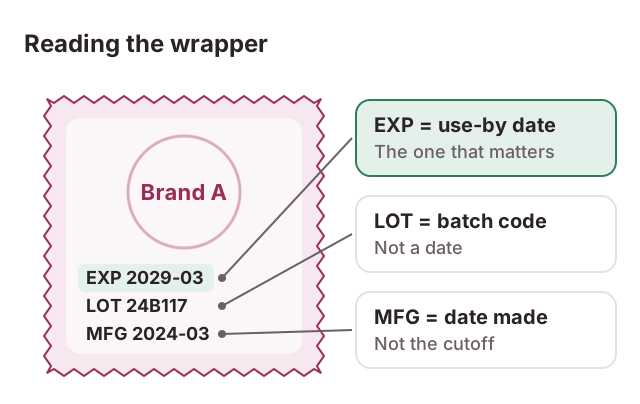
Check two spots:
- The individual wrapper. It’s usually stamped along the edge or the crimped seal. FDA labeling guidance for latex condoms requires an expiration date on each individual foil packet, not only on the box.
- The box. The date is stamped on the outer packaging too.
The wrapper is the one to trust. Loose condoms tend to outlive their boxes: the one at the bottom of a bag, the handful from a clinic bowl, the spare a friend gave you. If you can’t read a date on the wrapper, treat it as expired.
How to read a condom expiration date
Formats vary by manufacturer. The FDA’s example label reads “EXP Date: Jan 20XX,” while other wrappers use only numbers, such as “EXP 2029-03” or “03/2029.” When you see a four-digit number, that’s the year; the shorter number is the month.
You may see up to three codes printed together:
- EXP (or “use by”): the expiration date. This is the only one that tells you whether to use it.
- LOT: a batch code for the manufacturer’s tracking. It isn’t a date, even when it contains numbers that look like one.
- MFG: the date the condoms were made, on packs that include it.
When the label shows only a month and year, we’d treat the start of that month as the cutoff. Nothing on the wrapper promises you the whole month.
How long do condoms last?
For latex condoms sold in the US, FDA guidance caps the expiration date at five years from the date of packaging. Here’s how the main types compare:
| Condom type | Typical shelf life |
|---|---|
| Latex (no spermicide) | 3 to 5 years, and no more than 5 years from packaging |
| Most non-latex (polyurethane, polyisoprene) | 3 to 5 years |
| Spermicide-coated | Shorter than the same condom without spermicide |
| Lambskin (natural membrane) | About 1 year |
Planned Parenthood of Greater Texas gives the 3 to 5 year range for latex and most non-latex condoms and the one-year figure for lambskin. Cleveland Clinic notes that spermicide-coated condoms expire sooner. The printed date on your condom beats any rule of thumb, though, because it reflects that specific product. If you’re choosing between materials for other reasons, our latex vs non-latex guide compares them.
What heat, friction and wallets do to condoms
An expiration date assumes reasonable storage. Planned Parenthood of Greater Texas says condoms kept out of extreme temperatures, and out of high-friction spots like a wallet, should stay effective until their date. Store them badly and that promise no longer holds.
The specifics from the sources:
- Temperature: FDA guidance tells manufacturers to label latex condoms to be stored in a cool, dry place below 100°F and out of direct sunlight.
- Pockets, cars and bathrooms: Planned Parenthood advises against keeping condoms in your pocket, car or bathroom for more than about a month, because heat and moisture damage them over time.
- Sharp objects: keep them away from keys, pens and anything else that could nick the wrapper.
So the glove compartment in July, the gym bag that lives in the trunk, and the wallet you sit on every day are all bad long-term homes. A drawer at home is fine. For carrying, rotate condoms out of your wallet or bag regularly and replace them, rather than letting one ride around until the date runs out.
The 10-second check before you use one
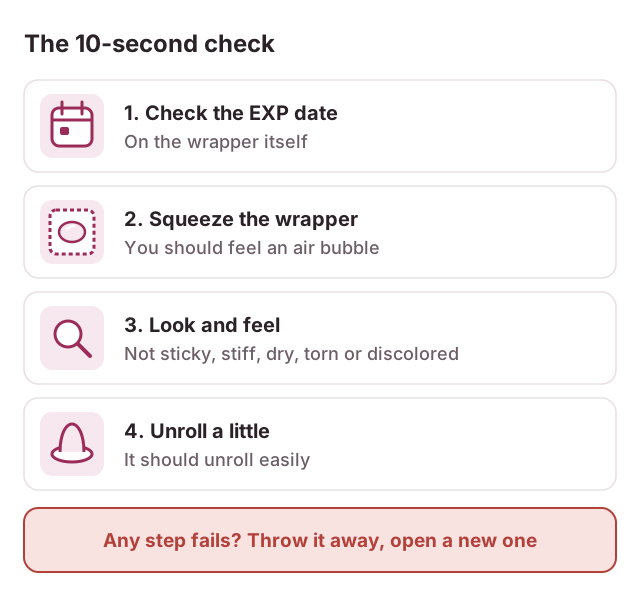
- Read the date on the wrapper itself.
- Squeeze the wrapper. Planned Parenthood says you should feel a little air bubble. A wrapper that feels flat may have a hole in it.
- Open it with your fingers, not your teeth or scissors.
- Look and feel. If the condom is torn, dry, stiff or sticky, Planned Parenthood says to throw it away. FDA labeling guidance adds brittle condoms and any with uneven or changed color.
- Unroll a little. If it doesn’t unroll easily, FDA guidance says it may be on backwards, damaged or too old. Don’t flip it over and reuse it; start again with a new one. Our condom guide walks through putting one on correctly.
If every condom you open feels tight or awkward even when it passes these checks, the problem may be size, not age. Our condom size chart and size calculator can point you to a better fit.
Can you use expired condoms?
Don’t, if you have any choice. An expired condom won’t necessarily break, but it’s more likely to, and the date is the manufacturer’s line for how long the condom is meant to hold up. Planned Parenthood of Greater Texas is blunt about it: if your condom is expired or hasn’t been stored properly, pause sex until you can get new ones.
The same goes for adding extra lube to an old condom to “help it along.” Lube doesn’t restore weakened material, and the wrong lube can make things worse: Planned Parenthood warns that oils, from petroleum jelly to coconut and other cooking oils, damage latex and polyisoprene condoms. If you’re unsure what’s safe with your condom, the Lube Compatibility Checker will tell you.
Used an expired condom? What to do next
First, think about what actually happened.
If it broke, slipped off or leaked, or you aren’t sure, treat it like any other condom failure:
- Pregnancy: emergency contraception (the morning-after pill) can help prevent pregnancy up to 5 days after unprotected sex, according to Planned Parenthood. Don’t wait to see what happens.
- HIV: if there’s a chance of HIV exposure, the CDC says PEP must be started within 72 hours, and the sooner the better. Call a health care provider, or go to an urgent care center or emergency room.
- Other STIs: book an STI test, and ask the clinic when to test so the result is reliable.
If it stayed on and intact, there’s no way to check after the fact whether an old condom let anything through. If pregnancy would be a problem, emergency contraception is the cautious move. Then throw out any other condoms from the same batch and restock.
Frequently asked questions
What does the expiration date on a condom mean?
It’s the last date the manufacturer says the condom should be used. Condoms weaken with age, and for latex condoms sold in the US, the date can’t be set more than five years after packaging. After it, the condom is more likely to break.
Where is the expiration date on a condom?
On the edge of each individual wrapper and on the outer box, usually next to “EXP.” If the box and a loose wrapper ever disagree, go by the wrapper in your hand.
How long do condoms last in a wallet?
Not long. Planned Parenthood advises against keeping condoms in a pocket for more than about a month, and a wallet adds friction. Keep a wallet condom as a short-term backup and swap it out regularly, whatever the printed date says.
Do condoms expire if they’re unopened?
Yes. A sealed wrapper doesn’t stop the material from aging, so a condom can expire without ever being opened. Check the date even on a box you’ve never touched.
Sources
Spotted an error or something out of date? Email [email protected] and we’ll take a look.
More guides

Guide · Toy Safety & Care
Body-Safe Toy Materials: What to Choose and What to Avoid
Not every material is equally safe. Learn which materials are non-porous and easy to clean, and which ones to avoid.
Updated

Guide · Toy Safety & Care
How to Buy Sex Toys Discreetly: Packaging, Billing and Delivery
What discreet shipping really looks like, what shows up on your bank statement, and how to keep emails, deliveries and gifts private in a shared home.
Updated