Condom Size Chart and Calculator: Find Your Fit by Girth
Use our condom size chart to turn your girth in inches into a nominal width in mm, learn how to measure, and fix condoms that feel tight or slip.

Condom size comes down to girth, not length. Measure around the thickest part of your erect penis, then match that number to a condom’s nominal width, the width printed on the box in millimeters. If your girth is between about 4.5 and 4.85 inches, a standard condom (52–56 mm wide) is the place to start; below that, look at snug sizes, and above it, large.
Want the number without the math? Our condom size calculator does the conversion for you, using exactly the chart below.
Condom size chart by girth
Find your erect girth in the left columns, then look for that nominal width on the box.
| Fit | Your erect girth (inches) | Your erect girth (cm) | Nominal width to look for |
|---|---|---|---|
| Extra snug | Under 4.24 in | Under 10.8 cm | Under 49 mm |
| Snug | 4.24 to 4.50 in | 10.8 to 11.4 cm | 49 to 52 mm |
| Standard | 4.50 to 4.85 in | 11.4 to 12.3 cm | 52 to 56 mm |
| Large | 4.85 to 5.19 in | 12.3 to 13.2 cm | 56 to 60 mm |
| Extra large | 5.19 in and up | 13.2 cm and up | 60 mm and up |
Each band includes its lower number, so a measurement that lands exactly on a boundary belongs to the wider band. The inch boundaries are rounded to two decimals.
How we calculate it (and why you should know)
There’s no official formula for condom fit, so here’s ours in full. We multiply your girth in millimeters by 0.455 to get a suggested nominal width. In inches, that works out to roughly girth × 11.56. A few examples:
- 4.25 in girth → about 49 mm (snug)
- 4.6 in girth → about 53 mm (standard)
- 5.0 in girth → about 58 mm (large)
- 5.5 in girth → about 64 mm (extra large)
We calibrated that factor on two published reference points. Cleveland Clinic gives the average erect girth as 4.6 inches, which is 116.8 mm. ONE Condoms says its standard condoms, which are 53 mm wide, “fit most people comfortably.” Setting the average girth to land on 53 mm gives a factor of about 0.455. A systematic review of measurements taken by health professionals lines up with that average: across 381 men, mean erect circumference was 11.66 cm, or about 4.6 inches.
That factor means the condom’s own circumference ends up about 9% smaller than your girth, which matches ONE’s advice to choose a condom circumference “slightly tighter” than your penis. It’s a reasoned starting point, not a clinical standard. The calculator shows a range of about 2 mm either side of your estimate, and the brand’s own size chart always wins over ours.
How to measure girth for condom size
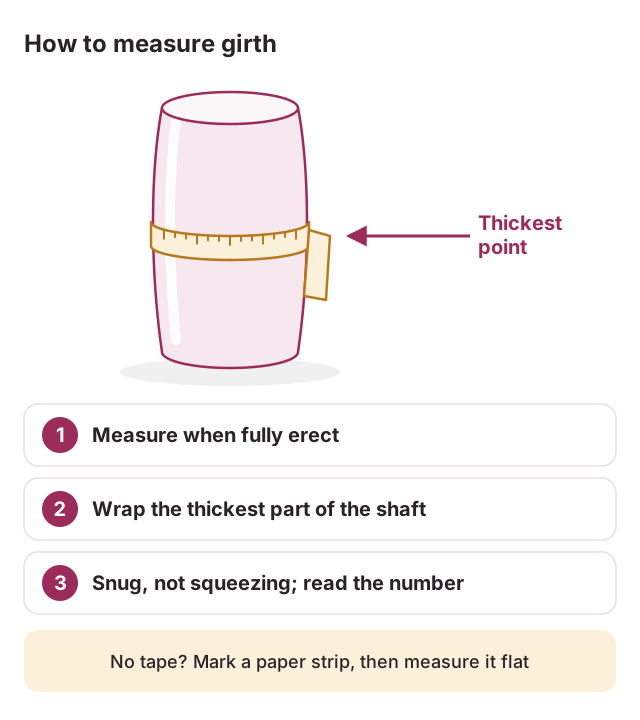
You need a soft, flexible tape measure. No tape? A strip of paper or a piece of string works.
- Measure when fully erect. Cleveland Clinic notes that the sizes on condom packaging are based on a fully erect penis.
- Wrap around the thickest part of the shaft. Cleveland Clinic calls it the widest part of the shaft, and ONE Condoms says the thickest part. Same spot.
- Keep it snug, not squeezing. The tape should lie flat against the skin all the way around.
- Read the number where the tape meets its start. With paper or string, mark the overlap with a pen, lay it flat against a ruler and read the length.
Measuring twice, on different occasions, helps if your first number sits right on a boundary in the chart.
What is nominal width on a condom?
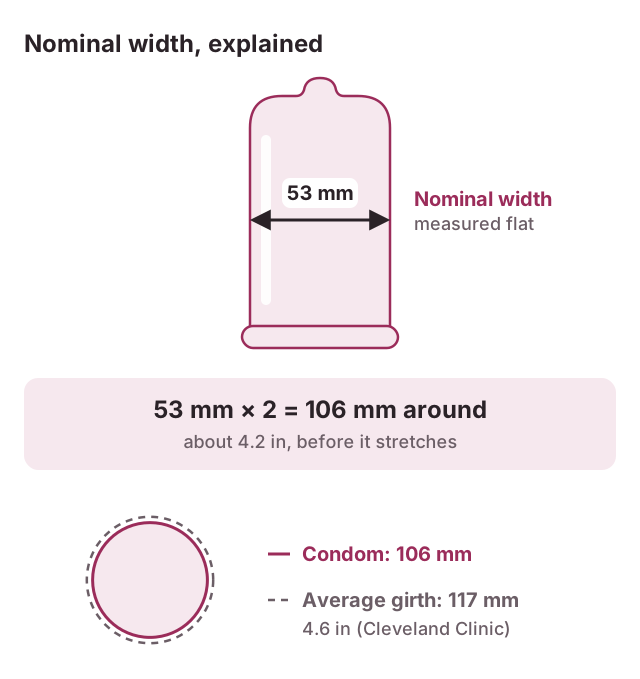
Nominal width is the width of the condom when it’s laid flat. ONE Condoms calls it the “lay flat width.” Because you’re measuring two layers, doubling the nominal width gives you the condom’s circumference, roughly.
So a 53 mm condom is about 106 mm around, or about 4.2 inches. That’s less than the 4.6-inch average girth, on purpose: the condom stretches to grip. That stretch is also why Cleveland Clinic says most condoms will fit most people. Still, the most useful number on the box is the width in millimeters.
What about length? (And condom size for 6 inches)
Length rarely decides your size. According to Cleveland Clinic, FDA guidelines set a minimum length of 160 mm (about 6.3 inches) for external condoms, and the average erect length is about 5.2 inches. ONE Condoms’ standard condoms are about 7.5 inches (191 mm) long.
So if you’re 6 inches long, standard-length condoms cover you, and you might have some condom left rolled at the base. Cleveland Clinic says that’s fine, and some people prefer how it feels. Choose your size by girth. If “6 inches” is your girth, that’s well into the extra large band, so look for the widest size a brand makes.
Why condom sizes differ between brands
- Names aren’t numbers. “Snug,” “regular” and “XL” are labels. Compare the nominal width in millimeters when the brand prints it, or check the brand’s own size chart, which Cleveland Clinic recommends.
- Brand ranges are broad. Cleveland Clinic cites Trojan’s standard condom as fitting a girth of 4 to 5 inches. That one “standard” spans four of our five bands, from extra snug to large. ONE Condoms, by contrast, sells numbered widths from 45 mm to 64 mm.
- Widths come with tolerances. In one FDA clearance summary, a 53 mm polyisoprene condom was specified at 53 ± 2 mm wide and 190 ± 10 mm long. Two condoms with the same printed width can differ slightly.
- Material and cut change the feel. Cleveland Clinic compares it to jeans: different brands and cuts suit different people. Our latex vs non-latex guide covers how the materials differ.
Condom too tight, slipping or not reaching the base?
Fit isn’t only about comfort. In a survey of 436 men, the 44.7% who reported ill-fitting condoms were more likely to report breakage (adjusted odds ratio 2.6), slippage (2.7) and taking the condom off before sex was over (2.0). It was a self-selected online sample, so treat it as a strong hint rather than a precise risk estimate.
Here’s how to read the signs, based on Cleveland Clinic’s fit chart and ONE Condoms’ guidance:
It feels too tight
Uncomfortable squeezing or losing your erection are signs to try the next band up, which usually means a few millimeters wider. ONE Condoms notes that a condom that’s too tight can cause bunching, squeezing, erection loss and even slippage.
It slips or bunches up
If the condom feels baggy, leaves a thick roll of extra condom at the base, or you’ve lost sensation, Cleveland Clinic suggests a smaller size. But ONE Condoms points out that a too-tight condom can slip too, so if it was squeezing before it slipped, go wider, not narrower.
It doesn’t reach the base
Cleveland Clinic calls this “a clear sign to try a bigger size.” Check it isn’t on inside out first. Our condom guide covers putting one on correctly.
It breaks
Cleveland Clinic lists breakage as a reason to go up a size or try a thicker condom. Before you blame the size, rule out two things that have nothing to do with it: your lube (check it with the Lube Compatibility Checker) and the condom’s age and storage (here’s how to read a condom expiration date).
Frequently asked questions
What size condom should I buy?
Measure your erect girth at the thickest point and use the chart above. If your girth is between about 4.5 and 4.85 inches, start with a standard condom of 52 to 56 mm nominal width. Under that, try snug; over it, try large.
Is there a condom size calculator?
Yes. Our condom size calculator converts your girth into a suggested nominal width and fit band using the same formula as this chart. Treat the result as a starting point, and check the brand’s own size chart before you buy.
What condom size is right for a 6-inch penis?
If 6 inches is your length, length isn’t the issue: standard condoms are at least 160 mm (about 6.3 inches) long, and many are longer. Pick your size by girth instead. If you measured 6 inches around, look at the widest sizes brands make.
How do condom sizes convert to inches?
Double the nominal width to get the condom’s circumference in millimeters, then divide by 25.4. A 53 mm condom is about 106 mm, or 4.2 inches, around before stretching. To go the other way, from your girth to a width, use the chart.
Sources
- Cleveland Clinic: Condom Size Chart: Does Size Matter?
- ONE Condoms: Sizing info and condom size chart
- Crosby RA et al. Does it fit okay? Problems with condom use as a function of self-reported poor fit. Sex Transm Infect, 2010
- Veale D et al. Am I normal? A systematic review and construction of nomograms for flaccid and erect penis length and circumference. BJU Int, 2015
- FDA 510(k) summary K231908: 45 Micron Polyisoprene Condom
Spotted an error or something out of date? Email [email protected] and we’ll take a look.
More guides

Guide · Toy Safety & Care
Body-Safe Toy Materials: What to Choose and What to Avoid
Not every material is equally safe. Learn which materials are non-porous and easy to clean, and which ones to avoid.
Updated

Guide · Toy Safety & Care
How to Buy Sex Toys Discreetly: Packaging, Billing and Delivery
What discreet shipping really looks like, what shows up on your bank statement, and how to keep emails, deliveries and gifts private in a shared home.
Updated