TPE vs Silicone: Is TPE Body-Safe, and Which Is Softer?
TPE vs silicone compared: porosity, cleaning, what phthalate testing found, which feels softer, and the label red flags behind “body-safe” claims.

TPE isn’t poison, but it isn’t silicone either. TPE (thermoplastic elastomer) is porous, so it can hold on to germs even after a good wash, while 100% silicone is non-porous and can be cleaned thoroughly. If two toys cost the same, silicone is the better long-term pick. If you love the squishy feel of TPE, keep it to yourself and put a condom on it.
The bigger worry is “jelly”, which often turns out to be soft PVC loaded with phthalate plasticizers. And “body-safe” on the box guarantees nothing, because nobody regulates the term.
Porous vs non-porous: why it matters for cleaning
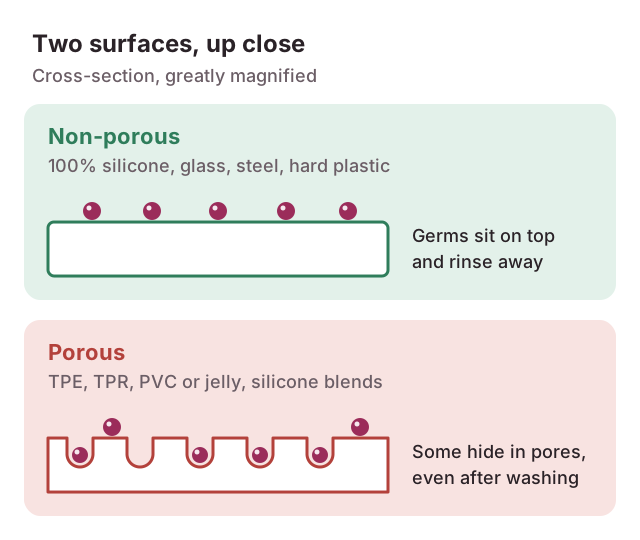
A non-porous surface is sealed. Soap and water reach all of it, so whatever you rinse off is gone. A porous material has microscopic gaps that fluids, lube and bacteria can work into, where washing can’t fully reach. Planned Parenthood puts it plainly: porous materials “can absorb germs that can lead to infections, even if you always wash your toy.”
One small study tested this. Indiana University researchers had 12 women use two vibrators, one TPE and one silicone. They swabbed each toy for HPV after use, again right after cleaning with a commercial toy cleaner, and again 24 hours later. Among the women who had vaginal HPV:
- TPE vibrator: HPV was on the shaft in 8 of 9 cases before cleaning and 5 of 9 right after cleaning. A day later, 2 of those 5 still tested positive.
- Silicone vibrator: 6 of 9 before cleaning, 4 of 9 right after cleaning, and none 24 hours later.
That’s a tiny sample, and finding viral DNA on a surface doesn’t prove anyone could catch it from there. Notice, too, that neither toy was HPV-free straight after cleaning, so a thorough wash matters whatever the material. But the 24-hour result fits the basic advice: silicone gives your cleaning routine a fair shot, and porous materials don’t.
What are TPE, TPR, PVC “jelly” and silicone?
Listings use these names loosely. Here’s what each usually means.
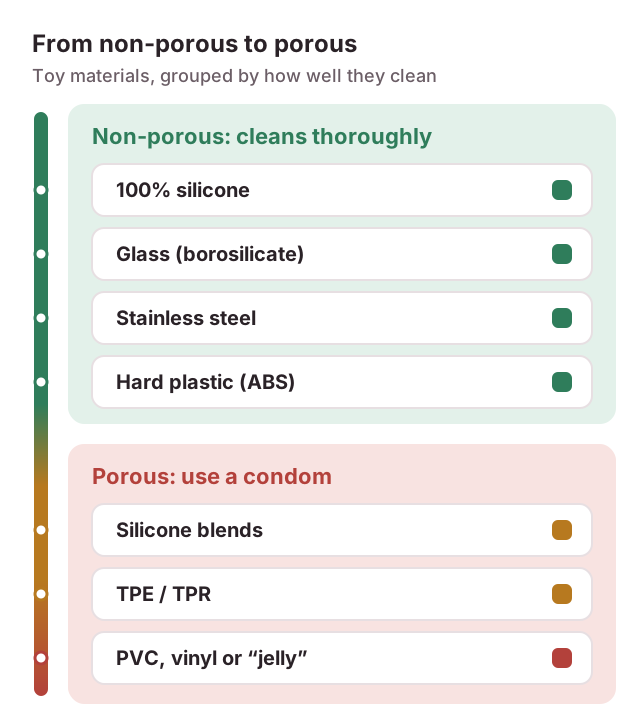
- 100% silicone. A synthetic rubber that’s non-porous and handles heat well. It comes in everything from firm to plush. Planned Parenthood’s wording is specific: “100% silicone (not silicone blends).”
- TPE and TPR. Thermoplastic elastomer and thermoplastic rubber: soft, stretchy plastics that soften when heated (the “thermo” part). Common in toys sold as “realistic” or “skin-feel”. Porous.
- PVC, vinyl and “jelly”. When Denmark’s Environmental Protection Agency had sex toys tested, it found that “jelly”, a widely used material name, “has turned out to be plasticized vinyl (PVC)”. Plasticizer made up as much as 70% of the material. Porous.
- Silicone blends. Silicone mixed with something else, in proportions the label rarely shares. Planned Parenthood lists blends among the materials that may be porous.
- Hard plastic (such as ABS), glass and stainless steel. Rigid and non-porous.
| 100% silicone | TPE or TPR | PVC or “jelly” | |
|---|---|---|---|
| Porous? | No | Yes | Yes |
| Can washing reach the whole surface? | Yes | No | No |
| Boiling or dishwasher? | Only if motor-free and the maker says so | No, it softens with heat | No |
| Sharing | Wash between partners, or use a fresh condom | Condom, and best kept to one person | Condom, and best kept to one person |
| Lube | Water-based; silicone lube can damage it | Water-based | Water-based (see below) |
Do TPE and jelly toys contain phthalates?
Phthalates are plasticizers: chemicals that turn rigid PVC soft and bendy. Several have caused reproductive and developmental harm in animal studies, which is why US rules cap eight of them at 0.1% in children’s toys. There’s no equivalent cap for adult toys.
The most detailed public testing we found is still the Danish EPA’s 2006 survey. It screened 16 products and ran migration tests, which measure what leaches out, on six of them.
- “Jelly” was PVC, plasticized with the phthalates DEHP, DNOP and DINP.
- At “normal use”, which the agency defined as once a week for 15 minutes, most products posed no health risk. The exception was a dildo that released a tin compound; the agency said it shouldn’t be used by anyone pregnant or breastfeeding.
- At heavy use, an hour a day, several products carried a “minor” or “possible minor” risk. DEHP was flagged for pregnant and breastfeeding users; other substances, such as phenol, for adults generally.
- Lube changed the numbers. Oil-based lube increased DEHP migration. With water-based lube it was about 100 times lower.
- Non-porous didn’t mean flawless. A hard ABS vibrator contained cadmium at 200 ppm, against a limit of 75 ppm.
A 2023 study led by Duke University researchers analyzed four toys: beads made of PVC, an anal toy made of PET plastic, a dual vibrator made of polyisoprene rubber, and an external vibrator made of a silicone blend. Phthalates turned up in all four, at levels above hazard warnings. One had been advertised as “phthalate-free”. The authors stress that four toys can’t represent the whole market.
Neither study shows that a TPE or jelly toy has made anyone ill. What they do show is that soft plastics can carry a lot of plasticizer, that nobody checks the claims on the box, and that heavy use and oil-based lube raise exposure. That’s enough for us to skip PVC jelly altogether and treat TPE as acceptable but limited: one person, a condom, and gentle care.
Is “body-safe” a regulated term?
No. Sex toys fall under the US Consumer Product Safety Commission, but the Duke-led researchers point out that it hasn’t set labeling rules or material standards for them, as it has for children’s toys. The FDA does classify a “genital vibrator for therapeutic use” as a Class II medical device, but that covers vibrators intended for treating sexual dysfunction or improving pelvic floor tone. Most toys are sold for pleasure, and many carry “for novelty use only”, which the same researchers note keeps them outside FDA medical-device rules.
Their best example: one package called the product a “novelty gag gift not intended for safe use” on one side and “body safe” on the other. Treat “body-safe” as the seller’s opinion and look for the material name. Our guide to body-safe toy materials covers the rest of the options.
TPE vs silicone: which is softer?
TPE, usually. It’s squishier and closer to the feel of skin, which is why it’s so common in realistic toys. Silicone covers a wider range, from firm to quite soft, and some silicone toys pair a softer outer layer with a firmer core (often sold as “dual-density”). Softness tells you nothing about safety: a plush 100% silicone toy cleans up exactly like a firm one.
How to clean and store each material
100% silicone
- Wash with warm water and a mild, unscented soap, or a toy cleaner.
- If it has no motor and the manufacturer confirms it’s safe, you can boil it for a few minutes or put it on the top rack of the dishwasher without detergent.
- Use water-based lube. Planned Parenthood warns that silicone lube can react with a silicone toy and damage it, unless there’s a condom on the toy. Our lube guide covers the other pairings.
- If it has a motor, the water-resistance rating decides whether it can go under the tap.
TPE and TPR
- Wash gently with warm water and mild, unscented soap. Scrubbing can scuff the surface.
- Skip boiling, the dishwasher and hot soaks. Thermoplastics soften with heat.
- Pat dry, then let it air-dry completely before you put it away.
- Use a condom for internal use or whenever anyone else will use it.
- Replace it once it turns sticky or cracked, or picks up a smell or stain that won’t wash out.
PVC and jelly
Clean it the same way as TPE, use only water-based lube, and always use a condom. If you have an old jelly toy in a drawer, this is a reasonable moment to retire it.
Storage for all of them
Give each toy its own clean pouch. Soft PVC can be more than two-thirds plasticizer, and plasticizers migrate, so you don’t want it pressed against your other toys for months. Keep everything somewhere cool, dry and out of direct sun, and use the same pouches when you travel with toys. For the full routine, see our cleaning and storage guide.
Label red flags (and why to skip the flame test)
Check the listing and the box for these:
- No material listed, or only vague words such as “body-safe”, “premium” or “medical-grade” with nothing specific.
- “Silicone blend”, “silicone-like” or “silicone feel”. That isn’t 100% silicone.
- “Jelly”, “jelly rubber” or “vinyl”.
- “For novelty use only”.
- “Phthalate-free” with no material named. That claim isn’t checked by anyone, and one tested toy got it wrong.
- A strong chemical smell, or a greasy or sticky surface straight out of the package.
Online, you’ll see advice to hold a lighter to a toy to prove it’s silicone. Skip it. It damages the thing you’re testing, you’d be breathing burning plastic, and a pass tells you nothing about additives: a flame can’t detect phthalates or cadmium. A better test is to ask the seller in writing what the toy is made of. A clear answer naming the material is a good sign. A dodge is your answer. (If privacy is part of why you shop online, our guide to buying toys discreetly covers packaging and billing.)
If you get burning, itching or a rash after using a toy, stop using it. If the symptoms don’t clear up once you’ve stopped, or you notice unusual discharge, see a gynecologist, your primary care clinician or a sexual health clinic, and mention the material if you know it.
Frequently asked questions
Is TPE body-safe?
It isn’t toxic by default, but it is porous, so it can’t be cleaned as thoroughly as 100% silicone. It’s reasonable for solo use with a condom, gentle cleaning and replacement when it starts to break down. For anything you’ll share, choose silicone, glass or steel.
Is jelly rubber safe?
“Jelly” is a marketing name, not a material. In Danish EPA testing it turned out to be PVC with up to 70% plasticizer, including the phthalate DEHP. Most products in that survey posed no risk at once-a-week use, but jelly is porous and its contents are rarely disclosed, so we’d pass.
Why is TPE not considered body-safe?
“Body-safe” usually means non-porous: something you can clean thoroughly. TPE can hold on to germs after washing, and in one small study HPV was still detectable on a TPE vibrator a day after cleaning but not on a silicone one.
TPE vs silicone: which is safer?
100% silicone. It’s non-porous, and motor-free silicone can be boiled if the manufacturer allows it. TPE is a budget compromise rather than a hazard, as long as you use a condom and don’t share it.
Sources
- Planned Parenthood: Sex toys
- Danish Environmental Protection Agency: Survey and health assessment of chemical substances in sex toys (2006), summary
- Anderson et al., Sexually Transmitted Infections (2014): Human papillomavirus on vaginally inserted sex toys, before and after cleaning
- Sipe et al., Microplastics and Nanoplastics (2023): Bringing sex toys out of the dark: exploring unmitigated risks
- FDA Product Classification: Genital vibrator for therapeutic use (21 CFR 884.5960)
Spotted an error or something out of date? Email [email protected] and we’ll take a look.
More guides

Guide · Toy Safety & Care
Body-Safe Toy Materials: What to Choose and What to Avoid
Not every material is equally safe. Learn which materials are non-porous and easy to clean, and which ones to avoid.
Updated

Guide · Toy Safety & Care
How to Buy Sex Toys Discreetly: Packaging, Billing and Delivery
What discreet shipping really looks like, what shows up on your bank statement, and how to keep emails, deliveries and gifts private in a shared home.
Updated